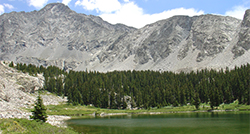
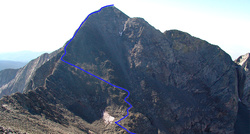
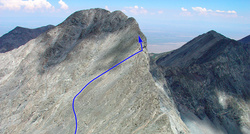
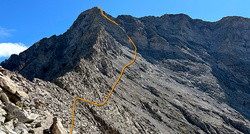
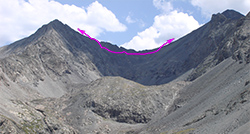
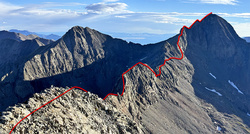
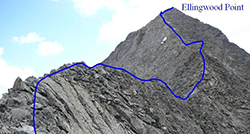
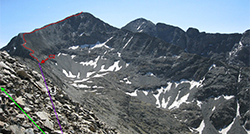
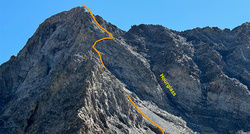
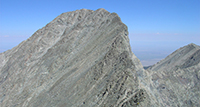
Little Bear Peak is one of the most difficult, dangerous, and mentally demanding 14ers in Colorado. Located in the rugged Sierra Blanca massif of the southern Sangre de Cristo Range, this peak is notorious for its loose rock, extreme exposure, and objective hazards. The standard
West Face route is defined by the infamous "Hourglass" couloir, a steep, narrow Class 4 choke point of polished rock. The Hourglass is a notorious bowling alley for rockfall, where any dislodged stone quickly channels down into climbing parties below, making a helmet mandatory and large weekend crowds a serious safety hazard. For more-advanced climbers, Little Bear serves as the starting point for the legendary
Little Bear-Blanca Traverse, a highly exposed, mile-long Class 4 knife-edge ridge that links to nearby Blanca Peak.
Frequently Asked Questions about Little Bear Peak
Do I need climbing skills to summit Little Bear Peak?
YES. While the standard West Ridge Hourglass and the West Ridge "Indirect" routes are rated as Class 4 and don't require a rope or harnesses for experienced mountaineers, they require high-level scrambling skills. You must be completely comfortable with near-vertical rock climbing on exposed terrain, precise foot placement, and utilizing your hands to pull your body weight up steep granite. It is an intense mountaineering objective that should never be attempted by hikers without Class 3 and Class 4 experience.
What makes Little Bear Peak one of the most dangerous 14ers in Colorado?
If you take the standard route, the primary hazard is The Hourglass, a steep, narrow upper couloir that can funnel rockfall dislodged by climbers above. However, the peak's danger is not limited to this single chute; the standard route demands high-exposure Class 4 climbing where a slip could be your last. While alternative paths like the West Ridge Indirect or the Southwest Ridge avoid the direct bottleneck of The Hourglass, they still cross highly unstable terrain, require complex route-finding, and feature extreme exposure that keeps Little Bear among the state's deadliest peaks. There are no easy routes on Little Bear Peak.
Can I easily traverse from Little Bear Peak over to Blanca Peak?
Absolutely not. The Little Bear-Blanca Traverse is widely considered the most difficult, terrifying, and dangerous of the four great 14er ridge traverses in Colorado. It is a highly sustained, mile-long knife-edge ridge of continuous Class 4 scrambling with massive, vertical drops of up to 1,500 feet on both sides. The rock can be loose and fractured, meaning a single handhold failure or dizzy spell can result in a fatal fall. It should only be attempted by mountaineers with excellent route-finding skills, solid nerves, and experience on exposed terrain.
What safety gear is mandatory for climbing Little Bear Peak?
A high-quality climbing helmet is mandatory on the upper terrain, including the lower gully if you approach from Lake Como. Because rockfall is a constant, unpredictable hazard generated by both human climbers, animals, and just normal rock movement, a helmet can literally save your life. Additionally, ice axe and crampons are required if you climb Little Bear in the snowy months, or late spring when the upper mountains still holds snow.
Additional Little Bear Peak History






 Blanca Peak
 Ellingwood Point