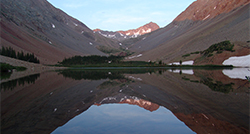
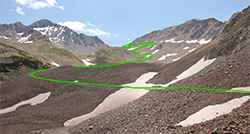
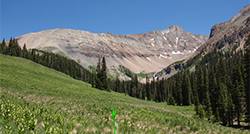
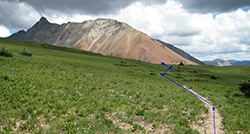
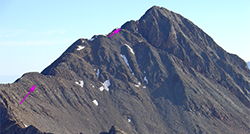
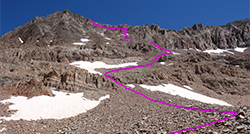
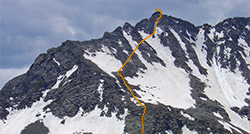
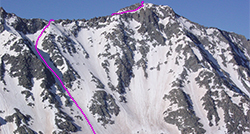
Mount Wilson is a remote, expert-level 14er in the San Juan Range's Lizard Head Wilderness, located 16 miles southwest of Telluride. As the highest point in the rugged "Wilson Group," it sits closely alongside Wilson Peak and unranked El Diente Peak, featuring complex route-finding and sustained Class 3–4 scrambling on loose rock. If you haven't climbed many 14ers, please hike/climb a bunch of
easier peaks before attempting any routes in the Wilson Group.
The area features a rich 19th-century silver mining history, with notable historical claims, sites, and ruins like the Silver Pick Mine and Morning Star Mine.Frequently Asked Questions about Mt. Wilson
Do I need a permit to camp in the basins surrounding Mount Wilson?
While you do not need to secure a competitive pre-booked wilderness permit or reservation to camp in the surrounding Lizard Head Wilderness, strict regional management rules apply. Specifically, the U.S. Forest Service has banned traditional dispersed camping within the Navajo Lake Basin. Hikers looking to stay overnight in Navajo Basin are required to use designated campsites identified by official physical markers and maps, and campfires are entirely prohibited in all basins.
How difficult is the El Diente to Mount Wilson traverse and what is the best approach?
The legendary El Diente to Mount Wilson Traverse is a serious, high-consequence Class 4 mountaineering route with exposure, loose rock, and complex route-finding. To tackle it safely, approaching the traverse from the south via the Kilpacker Basin is generally considered the easiest and most efficient method. Starting from Kilpacker offers a shorter, less fatiguing approach day and allows you to ascend El Diente's standard South Slopes first before tracking across the ridge. Then, descending Mt. Wilson's Southwest Slopes route.
Can I climb Mount Wilson, El Diente Peak, and Wilson Peak all in one day?
Bagging all three summits in a single day creates a massive, grueling endurance day. If you choose to attempt it, the most efficient method is to start at the Navajo Lake or Rock of Ages trailhead and ascend El Diente Peak's North Slopes route first, then traverse across the ridge crest to Mount Wilson, and hit Wilson Peak on your way back out. To do this safely, you should aim for early summer so you can climb the unstable North Slopes of El Diente when the couloir is filled with consolidated snow, avoiding severe summer rockfall hazards.
What is the naming history of this peak group and why are there two "Wilsons"?
The naming duplication dates back to the historical 1874 Hayden Geological Survey. Topographer A.D. Wilson climbed the highest point in the local cluster, which was officially named Mount Wilson (14,246 feet) in his honor. Later, when surveyors realized there was a completely separate, highly prominent independent 14er horn sitting just two miles directly north, they named it Wilson Peak (14,017 feet) after him as well. To round out the group, the adjacent jagged tooth was aptly given the Spanish name El Diente ("The Tooth").
Additional Mt. Wilson History






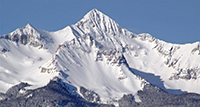 Wilson Peak
 El Diente Peak