| Report Type | Full |
| Peak(s) |
Mt. Yale - 14,200 feet |
| Date Posted | 08/11/2025 |
| Modified | 08/14/2025 |
| Date Climbed | 08/05/2025 |
| Author | Cairns |
| Yale the Long Way Around |
|---|
|
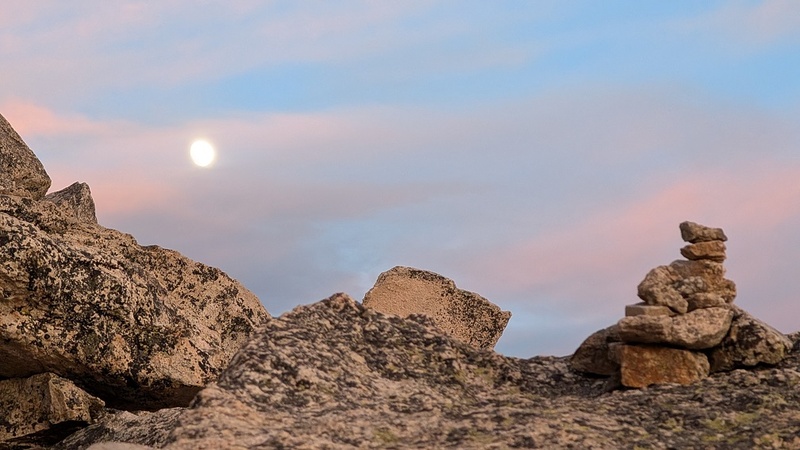
Yale the Long Way Around I scrambled through the final hundred vertical feet of boulders and stepped onto Yale’s summit just as the sun met jagged peaks many miles to the west—ten minutes later than I’d hoped. I set up my camera, and hurriedly fired off a few hero shots of myself at the highest point. Then the cold hit me. A slightly sweaty short-sleeve shirt, the relentless winds that had hammered the range all week, the elation of standing on top, and the growing unease about the long, uncertain route I still had ahead – all combined to leave me shivering uncontrollably. I retreated to a patch of rock barely sheltered from the wind, crawled into my sleeping bag, and tried to calm myself. From there, I captured the only photo I’d have the presence of mind to take for the rest of the hike: a surreal scene lifted from a movie set – a lone cairn, the full moon veiled by a wisp of cloud and nothing but sky beyond – even that beautiful scene couldn’t calm me.
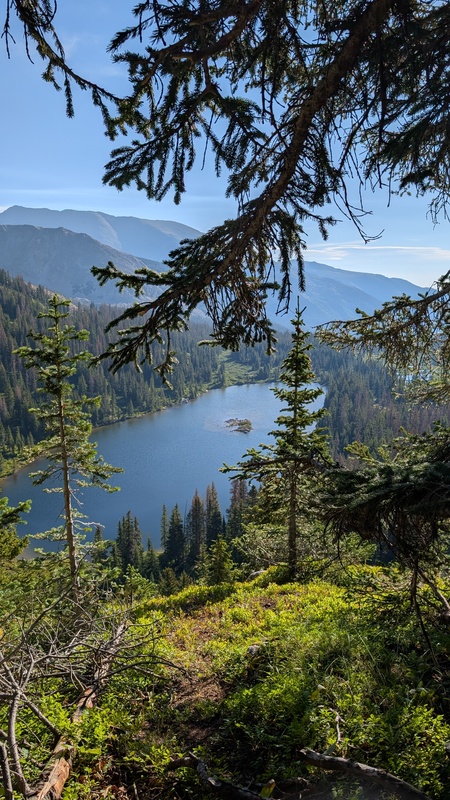
I’d been craving a solo, epic adventure—something that would take me above treeline, camping at an alpine lake, and up a 14er. Something that would test me. Exhaust me. Kroenke Lake and Mt. Yale fit the bill perfectly. Early Monday morning in Buena Vista, I grabbed a fat breakfast burrito and drove toward the trailhead at North Cottonwood Creek. My pack was heavy, my lungs not yet acclimated to the altitude, and my head buzzing with that mix of excitement and nervousness before a big effort. For the first leg, I had company—a friend joining me for the hike to Kroenke Lake. We set off at a slow, deliberate pace, the trail winding beside North Cottonwood Creek. The air was cool, the wind unusually relentless, and the rising and falling chorus of the creek a constant companion. We pitched camp beside the lake, took a quick nap, and spent the evening making dinner, wandering the shoreline, and setting up for some night photography. Just before dusk, a moose wandered silently up the trail beside our camp. It clearly had planned to spend the evening wading in the lake, doing whatever it is that moose do in a lake, however an audience seemed to give him pause. It eyed us suspiciously before turning around, content instead to enjoy the marshy willows downstream. Morning brought a parting of ways. My friend headed down the mountain, while I turned west and up. The trail wasted no time in climbing – steep, direct, and soon granting a shrinking view of Kroenke Lake far below. Willow carr crowded the edges of the trail, clawing at my thighs and obscuring the path in places. I pushed through the tangle until the slope eased and I crested an unnamed 12,500-foot pass. At the top, the wind struck like it was angry with me—steady, cold, and unrelenting – pushing against me with every step down toward Brown’s Pass. 
The route from Brown’s Pass to the Yale turnoff was easy, rolling terrain that mostly descended alongside a lively creek. I paused to refill my bottles in the cold, clear water, knowing it would be the last easy source before the next big climb. At Denny Creek, I found the trail junction for Mt. Yale, took a long breath, and started up. The path wasted no time – steep, rocky, and climbing a thousand feet in barely a mile and a half. My goal was to reach treeline and find a suitable campsite for a siesta before the final push to the summit. It was late morning and as expected, I was meeting a steady flow of hikers on their way back down, each offering a quick nod or a comment about the weight of my 40-plus-pound pack. Some looked skeptical, others impressed—but all knew I still had a long way to go. At 11,750’ I wandered off the trail to find a good dispersed campsite – a place to rest, refuel, and prepare for what I thought would be the final push of the trip. Little did I know that making it to the summit was just the beginning of the effort. As I pitched my tent and made lunch, a pair of robber jays loitered nearby, bold and calculating. Occasionally they would land amidst my stuff, within arms length of me, their eyes fixed on anything small enough to snatch. My lighter seemed to be their prize of choice. The plan – at least on paper – was a morning summit. But subconsciously, I’d always known that I was going to summit in the evening, with a full moon. I’d been telling myself for weeks that I’d summit in the morning but I’ve been on a 14er in the dark and it’s a glorious place. Subconsciously I knew, if the weather held and I was feeling froggy, I’d push to the summit in the late afternoon. It was no coincidence that on the date that I’d planned to climb, the moon would have already climbed high in the sky at sunset . Late in the afternoon I packed up camp, filled my water bottles one more time and started up. By now the late climbers were gone, it was just me and the trail and the sun slowly shrinking to the horizon. I calculated my pace—about a thousand feet an hour—so that I’d reach the summit at sunset. About half an hour in, a trail runner came past in shorts and a T-shirt, carrying little more than a headlamp and some water. Neither breaking pace, we exchanged quick pleasantries. I wondered where I’d be when he came back down. I got my answer not long after. We crossed paths again just as I reached the start of the technical section, the sun now an ugly smudge near the horizon, muted by a wisp of wildfire smoke—I guessed from the Lee Fire near Meeker. At the very top, a few mildly technical moves awaited—not hard, but tricky enough with a heavy pack strapped to my back. Failure likely wouldn’t be life-threatening but could get my SAR insurance helicopter pass punched – I have zero interest in ever cashing in that ticket, particularly if it involves a basket ride. I swung through each move cleanly and stepped onto the broad shoulders of Yale. 
--- --- --- Shivering uncontrollably in my sleeping bag, I realized warmth alone wasn’t going to help me – I needed to put my mind to work. Only focusing on the descent ahead could bring the distraction and calm I needed. I repacked my gear and set off. No trail. Strong winds. Darkness. And I would be doing it solo. I thought I knew what lay ahead, 14ers.com offered a solid write-up and photos of the East Approach, but it was from a climber’s perspective—not someone descending, and certainly not in darkness. Unlike the straightforward western approach – a single peak to climb – the eastern side was a jagged gauntlet of about twenty smaller sub-peaks, each demanding a choice: climb over or skirt around. None gave any visual clue as to the safest path. Thankfully I had a coarse GPS track to provide a hint to the best route to take. Often I’d stare at a looming peak ahead and doubt the GPS’s chosen route, but invariably, crossing to the other side proved my instincts wrong – and the alternative would have landed me in a tough spot. The first major sub-peak was one of the most daunting. Big, imposing, and the GPS insisted I go right over the top. By then the sun was long gone, and the full moon was hidden behind a thick cloud. My headlamp pierced only about thirty feet, casting shadows on the rocks ahead. I remember thinking it looked fake, like it was an old movie set – barren, with jagged boulders jutting in all directions. Shining my light off the ridge’s left edge revealed nothing but black emptiness. Curious and cautious, I inched closer to look over the edge to confirm the sheer drop off. I was grateful the GPS wasn’t sending me that way. Every sub-peak brought its own challenge. Rarely was there an obvious or well-traveled path. More than once, I found myself in a controlled slide down a scree field or double-checking my GPS only to realize I’d wandered well off course and had to improvise. Scree may have been work, but every minute spent dancing across a boulder field was blissful — an intuitive, methodical process, mentally demanding and physically engaging, with just a small degree of risk. Despite the technical challenges, I never felt out of control or unsafe. I never descended anything I couldn’t confidently climb back up. At one point, while skirting the south side of a ridge, I was clearly off track. The route ahead was open but demanded a real climbing move: a solid handhold jutting over empty space, flanked by reliable footholds. It wasn’t hard, but one misstep—like tripping on a shoelace—would have meant a substantial fall. Swinging out over that void with my center of gravity stretched far from my footholds was exhilarating, jolting me with adrenaline and energizing me for the peaks still to come. The ridgeline traverse was far longer than I’d imagined when planning this leg of the journey. It was the middle of the night, and I was both physically and mentally drained—still only about three miles into a five-mile stretch. I needed a break. On the downwind side of the ridge, I found something that actually resembled a trail and stopped to unpack my sleeping bag and cook kit. I brewed some hot chocolate, forced down a snack, and finally felt as if I could rest. The food was much needed and the warm drink calmed and warmed me. I laid on the trail exhausted enough to appreciate a conveniently placed rock that I used for a pillow. By then the sky was clear, the moon directly overhead and the stars were shining intensely. I laid there for an hour watching meteors and the vivid star scene. At some point I fell asleep, I don’t know for how long but I awoke with a start as I’d dreamed there was a bighorn sheep hovering over me. The traverse grew easier with each peak, though there was still no shortage of skree—just less intensity and exposure. Five hours in, around 2 a.m., I thought I could finally sense the end. Or so I believed. The traverse may have been complete but there, the east route for Yale meets the Colorado Trail where I still needed to hike north to Silver Creek. Another 3.2 miles. Mostly smooth and downhill, it should have been a quick sprint. But my mind was broken, and time was strangely distorted. I started down the Colorado Trail thinking I’d hike twenty minutes before checking my GPS. When I finally looked—satisfied with my impressive pace—it read two minutes. Two. I’d barely gotten started. The “final stretch” turned out to be 3.2 miles of steep, quad-burning downhill in the dark, with zero places to pitch a tent. The CO Trail isn’t about scenery or convenience; it’s about seeing how much you’ll put up with before you start bargaining with higher powers. When the trailhead finally appeared, I celebrated… for about five seconds. That’s when I remembered the Silver Creek trailhead and the North Cottonwood Creek trailhead—where my car was—were a mile and a half apart. Uphill. Naturally. So, I capped off the night with yet another grind and rolled into my car at 4:15 a.m. Tested. Exhausted. Mission accomplished.
Sean Cairns Thumbnails for uploaded photos (click to open slideshow): 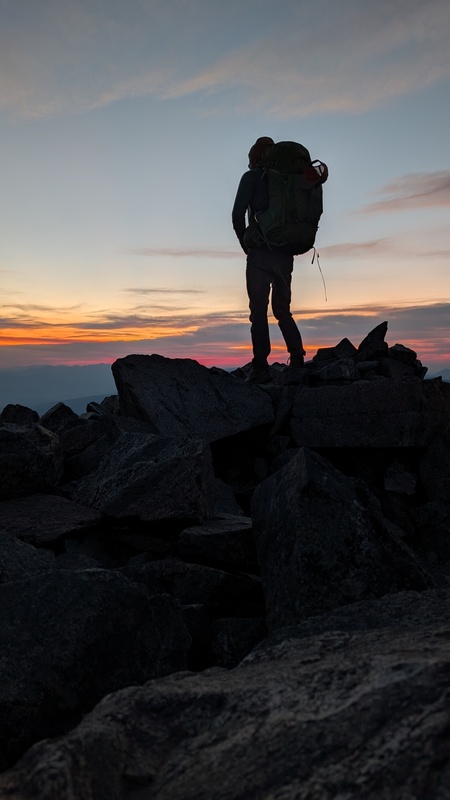
|
| Comments or Questions | |||
|---|---|---|---|
|
Caution: The information contained in this report may not be accurate and should not be the only resource used in preparation for your climb. Failure to have the necessary experience, physical conditioning, supplies or equipment can result in injury or death. 14ers.com and the author(s) of this report provide no warranties, either express or implied, that the information provided is accurate or reliable. By using the information provided, you agree to indemnify and hold harmless 14ers.com and the report author(s) with respect to any claims and demands against them, including any attorney fees and expenses. Please read the 14ers.com Safety and Disclaimer pages for more information.
Copyright: Route information, text, risk factors, maps, GPX files, charts, photos, 14ers.com-created map imagery, flythroughs, and other content provided in this route description are copyrighted by 14ers.com and may not be copied, reproduced, republished, distributed, modified, or used to create derivative works without prior written permission.
Please respect private property: 14ers.com supports the rights of private landowners to determine how and by whom their land will be used. In Colorado, it is your responsibility to determine if land is private and to obtain the appropriate permission before entering the property.