I cannot dance upon my Blazin’ Toes—
No man instructed me—
But oftentimes, within my mind,
A glee possesseth me—
I love winter. For a moment, it feels possible to exist without explanation. When the world moves too fast, winter grants permission to stand still—and to trust that time, like the earth, knows exactly what it’s doing.
Choosing to love always carries the risk of loss, yet we choose it anyway. But is loss really the thing to fear? Perfection, they say, occurs when there is nothing left to take away. We’re always certain we have more time. What if instead we embraced what is—with love—and trusted that making a difference is enough?
Something will get me eventually. Until then, I keep going.
My expiration date hasn’t passed. Staying young has less to do with denying age and more to do with appreciating the chance to grow old—being grateful for what’s in front of me while it’s still mine, even when it looks smaller than what came before.
This is my third ascent of Peak Fifteen in the last decade. At home, Marc and I argue about it. He says peaks are just piles of rock. To me, they aren’t. They hold stories, memory, and meaning. Somewhere along the way we invented a character named Skrat—who appears whenever I'm transfixed in the mountains. When we argue, I claim he suffers from Skrat Derangement Syndrome. Sometimes I get my way especially when I can explain that I’m performance-oriented, not end-goal driven.
Whiley, Ben, and I established a new route here on August 17, 2025. This time—December 22, 2025—I was alone. Solo mountaineering doesn’t bring the same joy it once did. Maintaining optimism can be difficult. Survivor’s guilt surfaces often: why am I the one who gets to be here? There’s no answer, and I’ve stopped expecting one.
What remains is the beauty. The animals. Falling asleep to a chorus of owls. Hearing a lone raven overhead while I climb. Seeing mountain lion tracks in the snow. These moments remind me I’m part of something larger, even when I feel singularly exposed. They make the solitude feel less like absence and more like belonging.
Overview
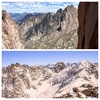
This report documents a new summer line on Peak Fifteen via the South-Left Gully, as well as a solo winter ascent on December 22 and the pictures will reflect that. The route offers better rock, cleaner movement, and a more direct line than the traditional Ruby Basin / Little Finger Saddle approach. It is an excellent alternative for parties seeking higher-quality climbing with fewer logistical compromises.
Much virtue in if—because uncertainty, not certainty, is the honest medium of alpine travel.
Summer Route
Approach: New York Creek (yep variation)
The summer line initially follows terrain familiar from the winter route before diverging decisively.
This is the southwest couloir and is located to the left of the standard southeast couloir.
Route Description (Summer)
-
From New York Creek, gain the lower basin angling left of the first Class 4 / low 5th boulder rock garden. There is fun movement here.
-
Continue angling left and up, avoiding broken, lower-quality rock to the right.
-
The route comes into alignment at the slab traverse, where movement becomes more deliberate. There is no logical protection along the traverse.
-
The Turret Saddle, zig-zag up and right on excellent rock in a small gully vs. aiming directly for the saddle, with solid, plentiful holds. Protection not required.
- At the saddle, uncoil the rope and enjoy excellent low fifth class climbing on quality rock with ample protection for ~300 feet.
-
The upper finish gets mean in classic San Juan fashion—kitty-litter rock, poorer quality, and a few committing moves that demand attention despite modest technical difficulty.
Character:
Good stone where it counts, thoughtful movement, and a clean line that rewards staying disciplined about route choice.
**This route is superior to the standard line, offering significantly less rockfall (with no evidence of rockfall observed in the couloir during a winter ascent), more intuitive route-finding, higher-quality rock climbing, and reduced commitment with straightforward bailout options. Exposure is lower overall, with fewer loose blocks and none of the “bowling alley” characteristics found on the standard route, allowing parties of two or more to climb comfortably without sending rocks down on one another.
However, additional work will be required to establish rappel stations; in the meantime, descent follows the original south gully, offering a natural transition to Peak Sixteen.
Winter Route — Solo, December 22
Approach: New York Basin
From New York Basin, head straight uphill from the New York Creek camp. There is a flat, established campsite at approximately 9,200 feet with a reliable water source.
Approach (Winter)
-
From camp, the route gains roughly 1,700 feet in 0.8 miles. Steep.
-
One headwall is bypassed around 11,000 feet, followed immediately by a significant avalanche trap.
-
This entire lower section is south-facing. During a previous winter visit in a similarly low-snow year, this terrain was largely dry. Not this time.
-
Above, about 1.5 miles of trees and shallow ravines involve straightforward bushwhacking, with knee-deep snow in places.
-
Snowshoes were deliberately left behind—postholing was preferable to hauling them through deadfall.
-
The upper basin is also south-facing but receives little sun; additional postholing followed.
Climbing (Winter)
-
At approximately 12,300 feet, technical climbing begins.
-
Based on satellite imagery, I expected either hard slab or a potential ice line to the right.
-
Instead, I climbed high into the first gully, then downclimbed ~30 feet to place tools and crampons.
-
Conditions were excellent: firm, supportive snow throughout. More springlike d/t aspect and lack of precipitation (although it snowed a little the night before).
-
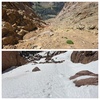
I continued upward, climbing approximately 1,200 feet of south-facing snow in ideal winter conditions.
Couloir Breakdown
The couloir divides naturally into four sections:
-
Lower Section: Moderate at first, steepening to ~40°, trending left.
-
Second Section: Noticeably easier and the widest part of the couloir.
-
Third Section: Tightens again; in heavier snow years may form small bergschrunds. Includes a mandatory off-camber rock step with limited handholds and poor rock, followed by a leftward jog.
-
Final Section: Turns sharply right, steepens, and improves in hold quality, leading directly to the saddle. Similar to the summer route.
Summit Finish (Winter)
From the saddle, approximately 350 feet of solid, enjoyable rock climbing leads to the summit. Protection opportunities are abundant, though the climbing is easy enough to free solo.
I carried rock shoes, a full winter rack, and a 40-meter rope—and used none of it. Just two ice axes and crampons.
Closing Notes
This summer route—established by me, Supra, and Whiley—offers a clean, logical alternative to Peak Fifteen that bypasses Ruby Basin and the Little Finger Saddle entirely. It favors intention over convenience and rewards restraint over force.
More details to come—especially expanded beta on the summer line.
For now:
Much virtue in if.
As with any mountaineering escapade, find death before death finds you.
On the train ride back to Durango I texted all my buddies and Marc of a successful outing and wrote him this poem:
I’ll be home for Christmas—
You can count on me.
Unless the forecast lies again…
Then I’ll be home eventually.
Hide the topo, hang the mistletoe,
It’s a long road back from 3am starts chasing thin air on ridiculous peaks, sleeping in frozen bivies.
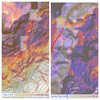
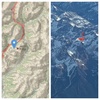
My GPS Tracks on Google Maps (made from a .GPX file upload):
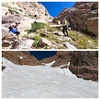
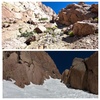
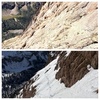
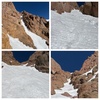
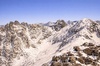
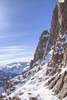
Thumbnails for uploaded photos (click to open slideshow):









|