| Report Type | Full |
| Peak(s) |
Mt. Powell - 13,556 feet |
| Date Posted | 12/01/2025 |
| Date Climbed | 09/01/2025 |
| Author | Gore Girl |
| Return to Mount Powell: An Attempt, Some Reflection, and a Completion |
|---|
|
RETURN TO MOUNT POWELL: AN ATTEMPT, SOME REFLECTION, AND A COMPLETION 13,556 (LiDAR)/13,580 (map) by Gore Girl August 21, 2024: The Attempt Each ascent traces, in some small way, the steps of those who first came here — yet this rainy morning allowed little room for such lofty thoughts. And the day already had a strike against it as far as climbing Mount Powell went: the weather for mid-afternoon was looking bleak. Nevertheless, group momentum, helped along by a touch of get-there-itis, had the cars pointed toward Piney Lake before dawn. Mount Powell had been an intention of mine for a while. But it had been getting pushed aside in favor of my usual Gore Range bushwhacks, extensive route-finding missions, and less obvious meanderings into the interesting, the untraveled, the “can I get there from here?” and “what’s over there” sorts of wanderings (and wonderings). Curiosity, I’ve found, is a suitable and interesting companion on my endeavors. On this particular day, I agreed to go with a small group of local hikers. The group kept a brisk pace on the first three miles of trail to the turnoff leading into the basin below Powell and Peak C. I hung back slightly, keeping counsel with my own thoughts and listening to the sounds of the forest awakening. I did manage to catch the group just before the turnoff, but their pace didn’t slacken on the climb into the basin, whereas mine definitely did. Once arriving in the meadow, I could see they were all seated, taking a break. This was something I was ready for as well. But as I arrived and sat, they all got up to go again. Thoughts of the weather were likely accelerating everyone’s pace and mindset. So, I urged myself to keep up, though I clearly needed to eat something for energy and couldn’t easily do so while on the move. A third of the way up Kneeknocker Pass, someone ahead shouted, “Rock! Rock!” Looking up, I saw a microwave-sized boulder bounding down the fall line straight at me. I had only one thought in mind: “Left? Or right?” as I tried to guess which direction to flee to avoid its erratic pathway downward. I ran to the left as quickly as I could as the boulder tumbled past. It clearly would have had disastrous consequences if it had hit me. The sudden adrenaline rush burned through my energy reserves, and my heart was still racing as I started upward again. Shake it off, I told myself. And keep going. I then realized everyone was well ahead of me, and attempted to move faster. It felt as though I were pushing against resistance though, each step an effort as I found myself fighting my way up. Continuing upward carried a sense of finality. The vague realization that everyone had kept going and hadn’t waited on top of the pass had occurred to me. But I rationalized the possibility away, because considering that thought had me clawing my way up the loose rock in an attempt to catch up. However, upon arrival at the top of the pass I saw that indeed, all had moved on, except for two folks who’d not planned on going farther that day. I was momentarily stunned. From the top of the pass, the group had already scattered as distant figures on Powell’s shoulder. That sight was conclusive: this wasn’t the way to climb the mountain. Before I could wrestle with the idea of hurrying on, my mind was made up: Stop. No more racing just to reach the top. It needs to be more than just a fight to keep up. In the moment, it wasn’t an easy decision to accept. But it was time to relinquish that thought and focus on first things first, which in my case meant food. After eating, clarity replaced fatigue. I will be back, I was already thinking, knowing I’d made the right choice. Gazing into the expanse of the Black Creek drainage behind the pass, I then turned back toward Piney Lake, clutching my hat as I did so to keep it from blowing away. Looking up one final time towards the hulking prominence of Mount Powell, I watched the small moving dots in the distance. Eager, faster, stronger, I noted with reluctance as I finally accepted my own decision to return to the trailhead. 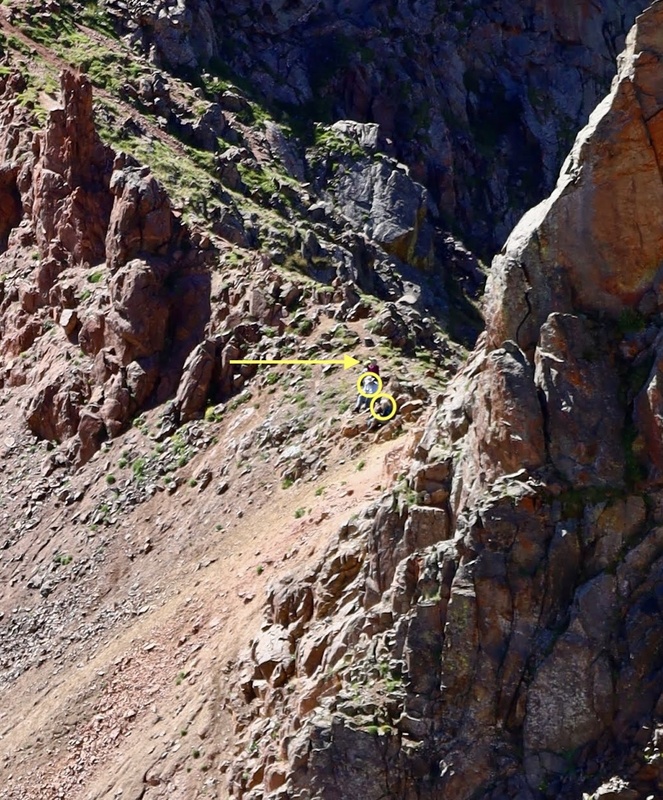
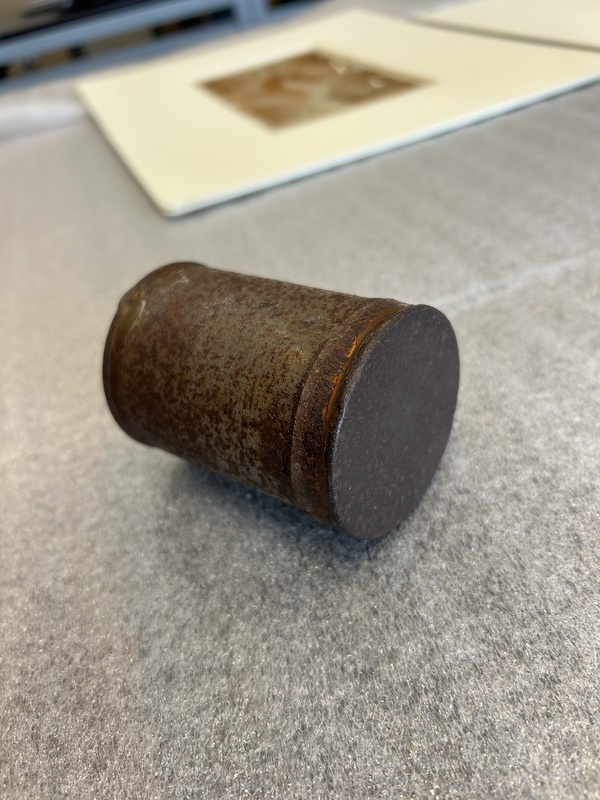
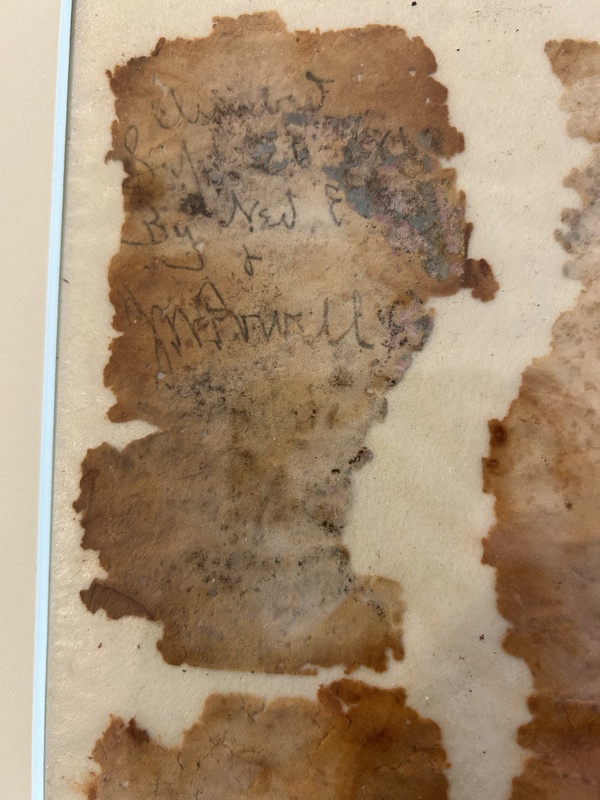
March 2025: Gaining Some Understanding Before returning to Mount Powell, I wanted a clearer sense of the climb’s historical context. I gathered a few sources to learn and understand more about this and what the early parties left behind. That work quickly made one point stand out: the original summit register was preserved at History Colorado. Seeing that register was an important step. It was the direct record from the first ascent, and it offered the only surviving physical link between Powell’s climb and the summit itself. So, on April 9, I found myself standing in front of a table at the museum. The docents had prepared the things I wanted to see in advance, and those items were now carefully laid out. I took one look at the collection and paused when seeing the tin and the register pages on the table before me. The tin’s size, the faded script, and the accompanying materials established a sense of the climb that no description alone could fully convey. It is fortunate that the tin and register — the oldest summit register in Colorado — were recognized for their historical value. Stored for decades in the State Historical Society collection, they were preserved in 1985 through a Colorado Mountain Club grant. Straightening up, I now surveyed the items before me. The rusted surface of the register tin gave no indication of its original use. A 1987 piece in The Vail Trail stated that the tin was used to hold chocolate candies, but its diminutive size suggests it could not have held many. Another source indicated that it was a “cocoa tin”, which the dimensions also don’t support. I wondered about the “chocolate/cocoa" association. Percy Hagerman’s Trail and Timberline article of 3/1/1932 gave a potential clue: upon his ascent of Mount Powell on 8/7/1913, he and the members of his party (P. B. Stewart, Wolcott Stewart, and Lowry Hagerman) signed their names on a chocolate wrapper. The presence of both the chocolate wrapper and the tin could have caused one to eventually be associated with the other. And it’s not much of a stretch to confound “chocolate” with “cocoa” either, being that the former is made from the latter. Given the size of the tin, there was a more realistic possibility. My mind flashed back to the text of a note by L. W. Keplinger about Powell's ascent of Longs Peak on August 23, 1868. The men had a routine of baking biscuits for their hikes. Prior to the ascent, the Major declared it was his turn to make the biscuits, which had formerly been done by one of his men. Keplinger stated: "Before leaving the summit we had put one of those biscuits inside the baking powder can upon which we had written, 'An everlasting memento to Major Powell's skill in bread making.' As we were about to leave the summit, the Major said that he wasn't quite satisfied with the biscuit feature; it was hardly up to the dignity of the occasion. We all insisted his true motive was his unwillingness to have the coming generation know how poor a bread maker so good a mountain climber was! But the biscuit was taken out." Powell evidently relented on the summit of his namesake regarding the matter of leaving a biscuit, as accounts from the 1873 Hayden Survey party indicate finding a dried-up biscuit in the tin. Looking back at the table, I immediately recognized the register tin as an 1860s baking powder can, obviously repurposed after a flurry of biscuit making and now sitting before me. Just to see it there along with the restored pages of the register, the latter signed with John Wesley Powell's and Ned Farrell's names — was a moment I had looked forward to for a long time. 

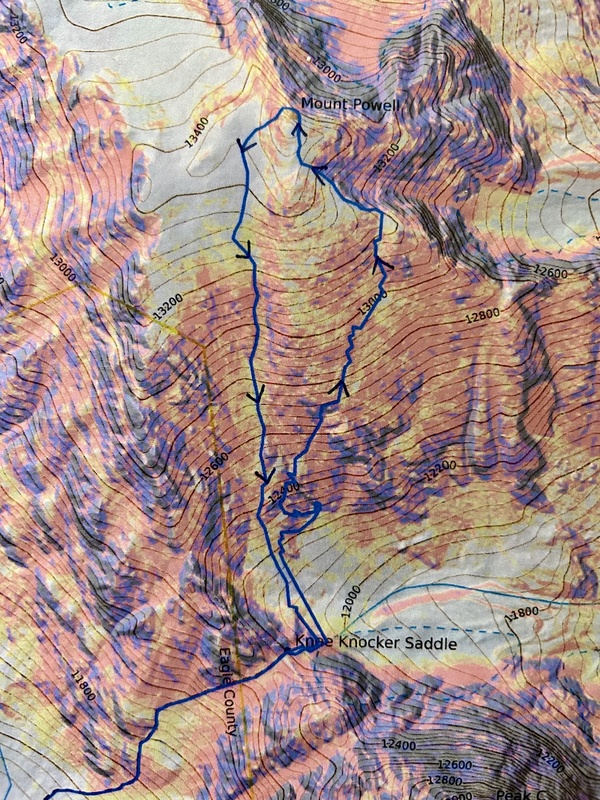
September 1, 2025: Completion and Success It was forecast to be a good weather day. And with a hint of fall in the air, it was ultimately the time to head back to Mount Powell. The first part of my journey passed uneventfully as I steadily made my way up Kneeknocker Pass, without the difficulties I’d experienced the first time. Standing on the pass, I glanced back at Piney Lake far below, nodding with satisfaction as I remembered the last time I’d been there. Then, without fanfare, I turned and paused at the invisible threshold to the Black Creek drainage. Taking my first step down the back side of the pass, I’d finally made it beyond my turnaround point of the previous attempt. Inching my way up the steep shoulder that forms the east ridge of Powell, I found myself eyeing Peak C periodically, noticing I was still having to look up to see its summit. This, of course, is relevant because Mount Powell towers above Peak C. Hence, until I could look down on it, I wasn’t even close yet —and already feeling tired. I’d not gone the standard route up the gully that led to the saddle west of the summit, planning instead to come down it with some calculated and careful sideslipping. The thought of fighting my way up something steep and loose was less desirable than climbing the mountain of large boulders off to the right. I made a couple of errors in judgment as I reassessed a few sections, retraced a couple of steps, and corrected my path. The summit was out of view to my left as I angled my way towards the top of the ridge. Large boulders graced the entire route, and every move was a full body effort: balance, reach, and pull myself up. 
I was running out of energy but could see what I thought was the height of land ahead. Only a couple hundred vertical feet more, I assumed. Rest stepping my way up, I then crested the ridge, noticing that there were still a few hundred more feet remaining off to my left. 
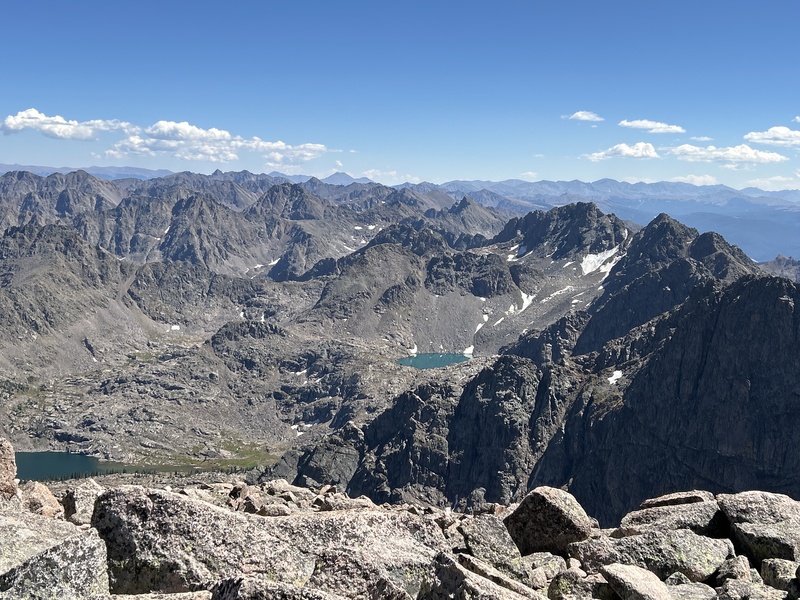
Finally, the ground rose no more. As soon as I realized I was at the summit at last, my breath caught; reaching the summit after months of preparation carried an unexpected impact. I looked around in every direction, as the view was expansive. Just as standing before the register and tin in April had offered a tangible link to Major Powell and his climb, so did this view. From the summit, Powell and Farrell would have seen the same topography — unmapped and unnamed, the Gore Range still a blank on contemporary charts. Within a decade, Hayden’s 1877 Geological and Geographical Atlas would inscribe the range and Mount Powell itself into the record. I looked for the summit register but couldn’t find one. Yet, this ultimately didn’t matter because I’d already found Powell’s register in the museum. This, I believed, was the most important connection to have made prior to my climb. 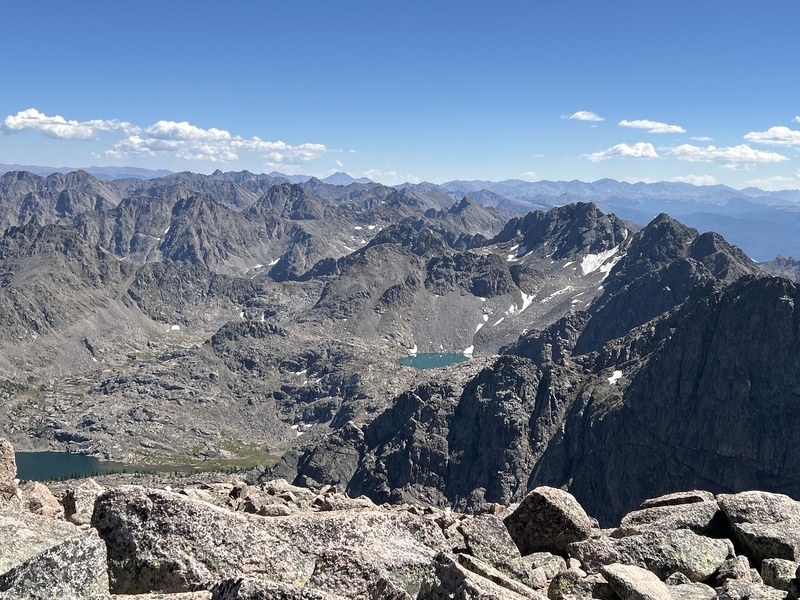
As far as the landscape stretching before me, Ned E. Farrell had said of Powell’s comments on the summit in 1868: “We had one of the finest views the eye of man ever witnessed…A description of the view can do it no justice.” And from my vantage point at that very spot — I understood exactly what he meant. Thumbnails for uploaded photos (click to open slideshow): 
|
| Comments or Questions | |||||||||||||||
|---|---|---|---|---|---|---|---|---|---|---|---|---|---|---|---|
|
Caution: The information contained in this report may not be accurate and should not be the only resource used in preparation for your climb. Failure to have the necessary experience, physical conditioning, supplies or equipment can result in injury or death. 14ers.com and the author(s) of this report provide no warranties, either express or implied, that the information provided is accurate or reliable. By using the information provided, you agree to indemnify and hold harmless 14ers.com and the report author(s) with respect to any claims and demands against them, including any attorney fees and expenses. Please read the 14ers.com Safety and Disclaimer pages for more information.
Please respect private property: 14ers.com supports the rights of private landowners to determine how and by whom their land will be used. In Colorado, it is your responsibility to determine if land is private and to obtain the appropriate permission before entering the property.