| Report Type | Full |
| Peak(s) |
Irving Peak - 13,216 feet Mt. Oso - 13,689 feet "Mt. SoSo" - 13,421 feet "P 1" - 13,235 feet "P 2" - 13,288 feet "P 3" - 13,279 feet Unnamed 13229 - 13,229 feet Peters Peak - 13,138 feet Unnamed 13144 - 13,144 feet "Weminuche Peak" - 13,240 feet |
| Date Posted | 08/06/2025 |
| Modified | 08/12/2025 |
| Date Climbed | 07/26/2025 |
| Author | yaktoleft13 |
| Additional Members | Marsh |
| Weminuche Wanderings Pt. 1: O So Fun! |
|---|
|
Here we are. The big trip for the summer. My wife was kind enough to suffer me 5 days out, and I was fortunate that Marshall was happy to come along for the trip. Being this deep in the wilderness alone can be an isolating experience, not always for the better. Without further ado: Whole Trip Stats: Trailhead: Hunchback Pass (day 1), Beartown (day 5) Days: 5 Distance: 69 miles Vert: 27,500 ft. Max difficulty: 4th class After last year's bittersweet experience at Balsam Lake solo, enough time passed that I was ready to embark on another Wemi trip. I knew the next trip would include the Oso/Peters group, as that was the largest cluster of unclimbed area for me, but there are a lot of peaks around the periphery of those that I was hoping to include in the same trip. The complicating factor, as always, is family. I don't want to spend more time away from them than is absolutely necessary to get things done, so I crafted a way to grab everything in the area as efficiently as possible. The plan was ambitious and had two distinct cruxes: day 1: hike in from hunchback pass, climb Irving/Oso/Soso (crux 1); day 2 hit the Peters group and Wemi peak; day 3 run up the Moon Lake unnameds, move camp to West Ute Lake, and tag 13,171 on the way (crux 2); day 4 head up Nebo group and 13,121, then head back to the car; day 5 climb Hunchback/White Dome/Peak 1/2/3; day 6 hit up the Ute Ridge group, then head back home. This would require 6 days of largely phenomenal weather, which is a rarity in the Weminuche, especially when the dates are locked in months in advance. I figured it was unlikely that we'd hit on 6/6 days, but even getting the first 4 days done would check off a huge area of the Wemi, as day 5 and 6 (as scheduled) are both daytrips from the car, which is logistically a lot easier. Not wanting to get my hopes too low or too high, I largely ignored the weather during the two weeks prior to the trip. But as the date of departure approached, an amazing thing happened; the forecast for our trip came out and it looked good. Not just good, but impeccable! Saturday and Sunday were forecasted to be crystal clear, and Monday had a large AM weather window and only isolated storms in the PM. That was more than good enough to green light everything, and was very lucky, given the prior week had been consistently stormy and we'd picked these dates two months in advance. Energized, I packed up my new 48 L Osprey and Friday afternoon began the long drive toward Silverton. I made it to the gas station at about 9:40 PM Friday night. I aired down my tires to 20 PSI, not wanting a repeat of my friends' popped tire on the road to Beartown, and headed up Stony Pass. I found the road bumpy and the rocks skittery, but nothing too difficult. After crossing the Rio Grande twice and driving through the open fields, I made it to the rock step, where I found my 4Runner's tires spinning. No worries, I thought, I'll just put it into 4Lo and give it a shot. I looked down to adjust the dial, and I found I never shifted the vehicle from 2wd to 4wd....I'd driven to the 11,200ish parking area in 2wd (which I guess dispels rumors of the road past the Rio Grande massively deteriorating in the last couple years and being 4wd only...also on the way down a BMW SUV was parked below the rock step so there's that). Correcting the mistake, I engaged the much more difficult last mile and a half of road with a more capable setup and reached the 11,750 parking area for the Hunchback Trailhead at 11:45, a full two hours after leaving the gas station in Silverton. I laid down in the back of the car, but sleep didn't come easily, and at 3:15 my alarm alerted my already awake body that it was time to guzzle down some coffee, liquid IV, and food, then gear up. Day 1: Backpack to Rock Lake, Irving, Oso, Soso Distance: 21.5 miles Vert: 8,100 ft Difficulty: 3rd class At 3:45 AM, I heaved my 36 pound backpack onto my shoulders and began the hike up to Hunchback Pass. Ignoring the few sets of eyes gleaming at me in the dark, I worked the cobwebs out of the muscles and reached the pass. Marshall had hiked in the prior day and climbed Wemi and the unranked to the west of the Rock Lake pass (I don't actually know the name of it), and he was going to get an early start on the Irving/Oso/Soso group, with the assumption I'd run into him at some point. I descended the loose trail to the south of Hunchback and eventually ran into some tents camped along the way. After about six miles, I reached the turnoff for Rock Lake, took off my headlamp, ate and drank something for the first time, and headed up. The Rock Lake trail was well-trodden, though slightly overgrown. Willows scratching at my shins made me wish I had long pants, or at least a machete. Unlike Marshall's experience from the prior day in which he cosplayed as a Toyota in a car wash, the willows and grasses were thankfully dry for me. I reached the large meadow below Rock Lake, wound my way through willows, and ascended the final slope up to the lake, arriving at about 8 AM, 4:15 after leaving the car. In case of an afternoon storm, I felt it was prudent to set up my tent and get my gear in it, so even if I got wet, the important stuff wouldn't be. I ate a bit more food and at about 8:30 set off up the trail to the pass and the Oso group, knowing so far I'd only completed the introduction. 

The way up to the pass was largely well trailed and cairned. Upon reaching the pass, I realized I didn't know what order in which Marshall was attempting the peaks, so I decided to go for Irving first, since it was the farthest away and most difficult to combine with any other day should it be orphaned. Also, I probably needed to get the farthest peak while my motivation was still high, if I'm being honest. At the pass I passed to the right of a bump, which put me directly under the unranked 058's slopes. To get to Irving, I first had to give up far too much elevation to reach the bottom of the basin, then climb a talus gully up to the Soso/Oso saddle. My legs still felt fresh at this point, so I dispatched the gully with ease and looked onto the remainder of the route. 
The rest of the way to Irving was, in one word....long. After descending the gully, there was still an entire broad basin to cross, complete with talus, willows, and trees (yep, had to drop below treeline), just to start heading uphill again. Still naive and weirdly fresh (trading a heavy pack for a day pack can give a false sense of invincibility), I went down, as fast as the loose talus would let me. I aimed to stay as high on the right as possible, but I had to end up below 12k feet in order to not sidehill nasty talus the entire way. The heat of the day started to pick up, and I began to feel the fatigue as I engaged Irving. A prominent ridge extends off the saddle with North Irving, and while I didn't tackle it from the very bottom, I wrapped around to the right, found some mildly loose terrain, and elected to climb up to the ridge. This led up to Irving's summit ridge, which went without incident, and I finally made the first summit of the trip! It only took about 15 miles to do so. It was right at the summit I ran into Marshall, who had done Oso first, then Irving. I also spied a couple of people exploring the ridge between North Irving and 13,027, which turned out (for the second time this year!) to be Heather Ryan, gallivanting around on a seldom-climbed unranked 13er. I made my stay on the summit of Irving a quick one and elected to skip North Irving, prioritizing getting to chat with Marshall a bit on the descent over an unranked 13er. 

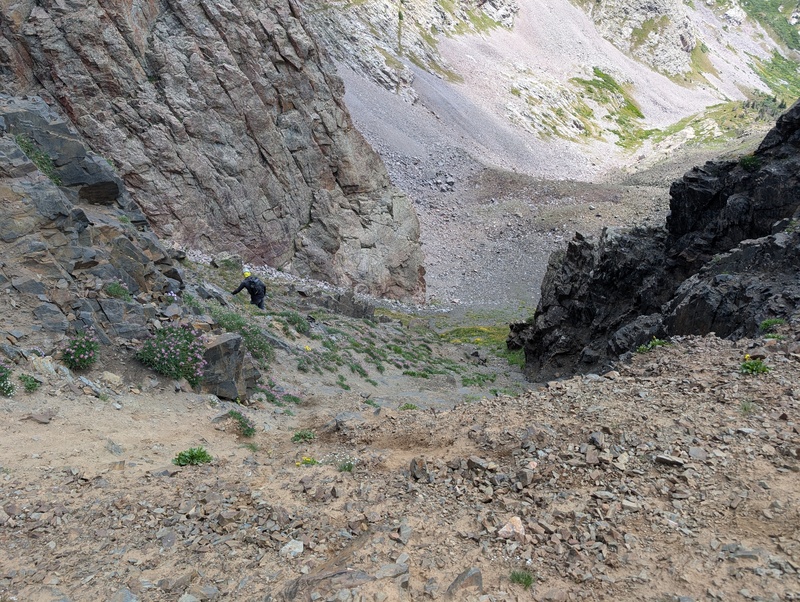
To descend, we elected to take the express way, which was a loose gully between Irving and N Irving. The 25 feet at the top of the gully were deadly steep and perilous, with scree over hardpan, but we inched down, yielding grassy tufts and more friendly scree. At the bottom, I bid Marshall farewell, as he went over toward Soso via the gully, and I had to go up Oso via his ascent route. I sidehilled at about 12.2k on some annoying loose talus to reach a small saddle along the ridge from N Irving to Oso, and once through it, found myself staring at 1,000 feet of talus, straight up to the Oso summit ridge. I put on some music and entered the zone, knowing each step I took is one less I had to take. It took what felt like forever (probably only like 35 or 40 minutes in actuality), but I reached the summit ridge of Oso, where I turned left and walked up the gentle crest to the summit. Peak #2 down, and the tallest one of the trip! It's all downhill from here, kind of.... 


At this point, I was worked. It looked strongly like the ridge proper between Oso and Soso didn't go, so I'd have to give up extra elevation just to reach the saddle. Plus, Soso was a solid 700 ft of additional gain from the saddle, and I was so ready to be done. I strongly considered leaving it and just tagging it on the Moon Lake unnameds day, but I forced myself to just get to the saddle and make a decision then. I did have to give up an additional 100-150 ft to get underneath the ridge difficulties, but once at the saddle, I talked myself into continuing, reminding myself that I had perfect weather, which meant being tired and slow wasn't an excuse, and that the Moon Lake 13ers day was a day with less perfect weather that would determine the success of the rest of the trip. With that in mind, I pressed on. 
Soso turned out to be a very interesting climb. I had no beta on this peak, other than a single GPX track that went vaguely up the ridge. I found quite a bit of scrambling on the peak, mostly 3rd class, all of it a good time. What stood out the most was the summit pitch. I (and I found out later Marshall as well) attacked the summit ridge head-on, climbing up until we found a scrambly line directly north of the summit for the last 200 feet or so. A little weaving and scouting yielded a 3rd class line, and with that, I was able to summit peak #3 for the day. Crux 1 complete, no orphans! I took my first extended break of the day, relaxing on the summit, before deciding it was finally time to head down, get to camp, and get some real (ehhhhhh....) food of the day. I backtracked my ascent route down to the saddle, headed down the gully, reascended about 500 feet of gentle terrain to the Rock Lake pass, and shot down the soon-to-be-familiar route to Rock Lake. 


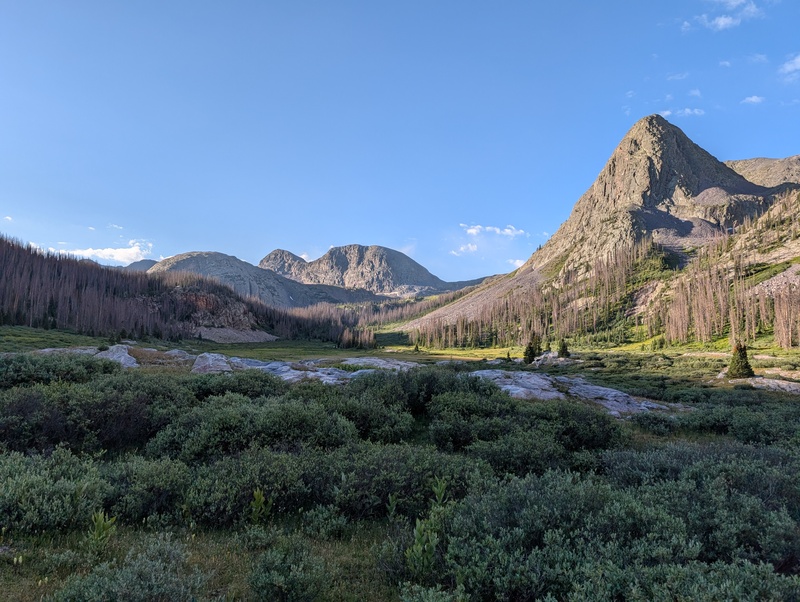
I made it back to camp at around 4:30, meaning I'd been going for about 12 1/2 hours with a short break setting up the tent as my only reprieve. I refueled, tried to drink enough water to rehydrate myself (failed), and hung out with Marshall back at camp before turning in for an early bedtime, knowing tomorrow was going to be one of the highlights of the trip. Day 2: P1, P2, P3, 13,229, Peters, 13,144, Weminuche Distance: 11.6 miles Vert: 5,400 ft. Difficulty: 4th class This was the day I was most excited to undertake. Everyone has glowing things to say about the Peters traverse, and I was ready to find out for myself. We got a pre-dawn start of 5 AM and backtracked down the Rock Lake trail for a couple of miles until we reached our turnoff. The meadow to cross looks chocked with willows, but they're the nice, friendly, knee-high willows, not the "oh my god where's the sky" kind of willows that sometimes appear. We probably should have angled a little further west before starting up the bushwhack slope, but we didn't, so we had some steep deadfall to navigate. After a couple hundred feet, we found a trail of sorts that meandered through the forest. We occasionally lost it, but always picked it back up again, and it spit us out in the meadow below P1. 

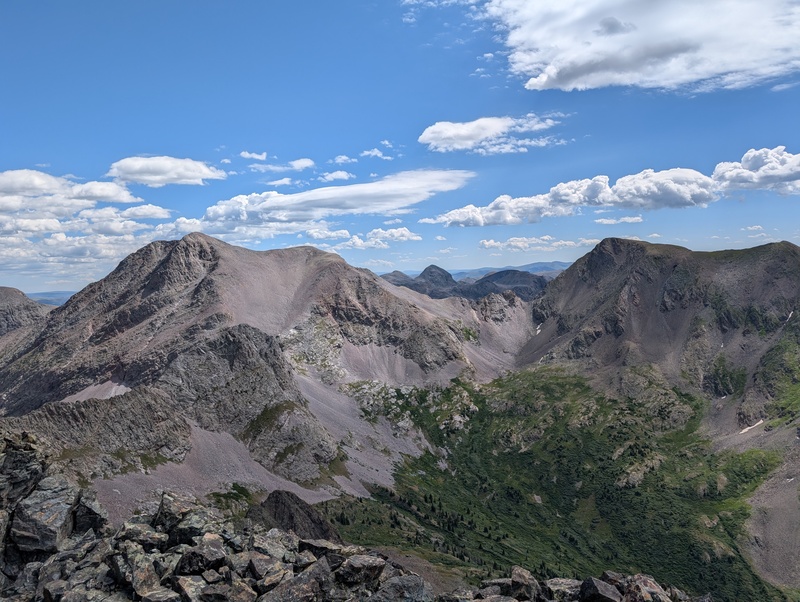
Once above treeline, a look to the left showed us the jagged ridge between P1 and P3, which constitutes the teeth of the Peters traverse. To the right we saw a broad, grassy gully that grants access to the NW ridge of P1. The gully was low-angle, and once on the ridge a bit of class 2 lead to the final down and up before P1, which was our first introduction to the slabtastic scrambling of the next couple of hours. When not on slabs, we had to check for loose rock, but everything that was slab on the whole traverse was bomber. 


P1 isn't ranked, so we deemed it unworthy of a break. We headed down its ridge at 3rd class until we reached the saddle with P2. P2 held some ups and downs, which afforded us views of the massive sheer east face of P1. We found more great slab scrambling along the ridge to P2. We elected to climb up a point along the ridge because the scrambling was so good, but then had to descend back toward the west to circumvent the cliffs blocking direct access to P2, using a couple of loose gullies. We got some bonus elevation gain that way and the detour didn't take long, so we were shortly thereafter standing on P2, our first summit of the day. 


After a proper break and refuel on P2, we were ready to engage the Slab up P2.5, which we knew was the technical crux of the day. A short but stout downclimb from P2 lead to the saddle with P2.5, and from there it's slab all day baby! The slab is probably no harder than tough 3rd or easy 4th, but the position, exposure, and rock were all exceptional, making it feel much more epic than it probably really was. But fun is in the eye of the beholder, and I beheld it to be awesome! 


Once on top of P2.5, the earnest scrambling of the Peters traverse gives way to talus. But that's not to say the fun is over! The downclimb off of P2.5 to reach the saddle with P3 held a bit of scrambling, and while the primary ascent up P3 was a talus slog, the last 100 feet or so up to the top of P3 held a knife's edge and some blocky, angled scrambling. Nothing we weren't up to the task of, however, and ranked summit #2 was ours. 


With our perfect forecast for the day, we pushed onward, but not in a hurry. We dropped a bit and ascended a bump on the ridge, then found a consistent 2+/3rd class scramble down to the low point between P3 and 229. As was unsurprising because we could see the face of 229 in its entirety, there were no hidden troubles on the ascent. We dodged the first high point, electing to traverse across the talus to the summit ridge, then scampered up to the top of 229. While a long way from P3, the ascent in particular took less time than we expected, since so much of the terrain was simple hiking instead of scrambling for the first time today. 


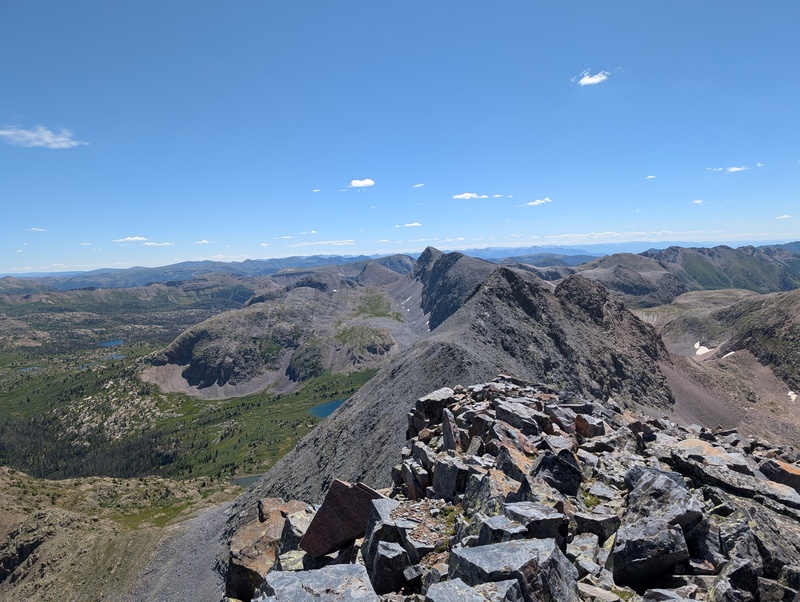
The descent from 229 toward Peters required a bit of care, but ultimately became a talus hop. So too was the ascent up Peters, which was much closer than the previous two peaks and also held straightforward terrain. We reached the top, under a brilliant blue sky, and celebrated our completion of the Peters traverse. A memorable one for sure! Maybe not an ultra-classic, as the second half of it becomes a little talus-sloggy, but well worth the backpack in, even if it's not expressly on your to-do list. 

The Peters traverse gets done in both directions, but I'd have to say our way was the better one. I think it made for the most logical scrambling, but more importantly, once we topped out Peters, we were less than an hour from camp! The descent was simple: backtrack the ridge a bit, head down to the saddle with 12er Buffalo Mountain, then turn right and head right to Rock Lake. The terrain was easy and relaxing, especially after so much time in tricky spots on the ridge. We made it back to camp about 45 or 50 minutes after leaving the summit of Peters. 

The unfortunate thing was I wasn't done for the day. Once at camp, Marshall got to relax for the rest of the evening, but I was one peak behind him and had to go tag Weminuche. I quickly made oatmeal and coffee, devoured them, and before I had time to think my way out of it started up the trail to Rock Lake Pass. From there, I turned left and climbed directly up the blocky talus that leads to 144. A short false summit led to the true summit, where I was annoyed to see that there was quite a drop between 144 and Weminuche. I cranked up the tunes, sang breathlessly on the way up, and reached the summit of Weminuche Peak a few minutes later. On the descent, I took the bypass to the south around 144, ending up at a saddle a couple hundred feet higher than Rock Lake Pass. I did a descending traverse on talus and grass patches to reach Rock Lake Pass, then beelined it down the trail to the tents. The whole extra ordeal took 2 hours and some change, but I was now caught up with Marshall in ranked peaks! (he had and would keep the edge on the unrankeds) 


Now back at camp for real, I focused on rehydrating and refueling. I took down over a gallon of liquids throughout the rest of the evening, did laundry, ate what had to be a thousand calories in peanuts, took a dip in the lake (as did Marshall), and geared up for tomorrow. Our pristine weather outlook was going to get a little more murky, and and we had some serious logistical challenges to overcome if we were to summit everything we needed to and move our camp to West Ute Lake before the storms hit. If we didn't make it, our Tuesday would become devilishly complicated. Would we make it, or would we get stormed out? To be continued... GPS Track(s) on Google Maps (made from a .GPX file upload):
View Map
Thumbnails for uploaded photos (click to open slideshow): 







|
| Comments or Questions | ||||||
|---|---|---|---|---|---|---|
|
Caution: The information contained in this report may not be accurate and should not be the only resource used in preparation for your climb. Failure to have the necessary experience, physical conditioning, supplies or equipment can result in injury or death. 14ers.com and the author(s) of this report provide no warranties, either express or implied, that the information provided is accurate or reliable. By using the information provided, you agree to indemnify and hold harmless 14ers.com and the report author(s) with respect to any claims and demands against them, including any attorney fees and expenses. Please read the 14ers.com Safety and Disclaimer pages for more information.
Copyright: Route information, text, risk factors, maps, GPX files, charts, photos, 14ers.com-created map imagery, flythroughs, and other content provided in this route description are copyrighted by 14ers.com and may not be copied, reproduced, republished, distributed, modified, or used to create derivative works without prior written permission.
Please respect private property: 14ers.com supports the rights of private landowners to determine how and by whom their land will be used. In Colorado, it is your responsibility to determine if land is private and to obtain the appropriate permission before entering the property.