Download Agreement, Release, and Acknowledgement of Risk:
You (the person requesting this file download) fully understand mountain climbing ("Activity") involves risks and dangers of serious bodily injury, including permanent disability, paralysis, and death ("Risks") and you fully accept and assume all such risks and all responsibility for losses, costs, and damages you incur as a result of your participation in this Activity.
You acknowledge that information in the file you have chosen to download may not be accurate and may contain errors. You agree to assume all risks when using this information and agree to release and discharge 14ers.com, 14ers Inc. and the author(s) of such information (collectively, the "Released Parties").
You hereby discharge the Released Parties from all damages, actions, claims and liabilities of any nature, specifically including, but not limited to, damages, actions, claims and liabilities arising from or related to the negligence of the Released Parties. You further agree to indemnify, hold harmless and defend 14ers.com, 14ers Inc. and each of the other Released Parties from and against any loss, damage, liability and expense, including costs and attorney fees, incurred by 14ers.com, 14ers Inc. or any of the other Released Parties as a result of you using information provided on the 14ers.com or 14ers Inc. websites.
You have read this agreement, fully understand its terms and intend it to be a complete and unconditional release of all liability to the greatest extent allowed by law and agree that if any portion of this agreement is held to be invalid the balance, notwithstanding, shall continue in full force and effect.
By clicking "OK" you agree to these terms. If you DO NOT agree, click "Cancel"...
The Big O' Bad MoFo's of ranked 12ers was crowned to Turret Ridge near Ridgway but the new LiDAR analysis has dethroned Turret Ridge and the newly crowned Bad Ass MoFo King of 12ers reigns to The Castles East. Colorado's 13er list has some challenging summits with the hardest being Lizard Head (class 5.8+) but the 12ers have Turret Ridge (5.9), Twin Peaks West (5.6), and now Castles East (5.10). The previous champion, Turret Ridge, is rated 5.9 R with the most challenging climbing being reasonably well-protected; however, the climb requires a high consequence R-rated traverse pitch clocking in at 5.6 – a scary endeavor for both the leader and the follower.
Immediately after the LiDAR analysis, elite full-fledged peak baggers searched in a frenzy for information on the elusive summit of Castles East. Some folks attacked the legitimacy of LiDAR, claiming that no one would complete the new Colorado 12er list, while others had their egos bruised since their status of Colorado 12er completer was stripped from them. The only information I found regarding the climbing on Castles East was on Mountain Project. At best, it is a cryptic and poor description with the original topo labeling the climbing as "5.10 WTF." Now, wtf does WTF mean?
Naturally, I have an attraction to climb ranked 5th class summits. Alyson contacted me about climbing Castles East to finish her impressive goal of summiting all the ranked 12ers in May shortly after surgery. She was particularly motivated after rebounding from some significant health issues with Metallosis. A weekend date was planned well in advance, which is unusual for me.
Arriving early Friday night, I met up with one of my stronger climbing partners, Aiden, who lives in Grand Junction. I glazed over John's e-mail about a potential camp and assumed a day trip as that doesn't require schlepping a ton of extra gear. Initially, I think he planned for two days.
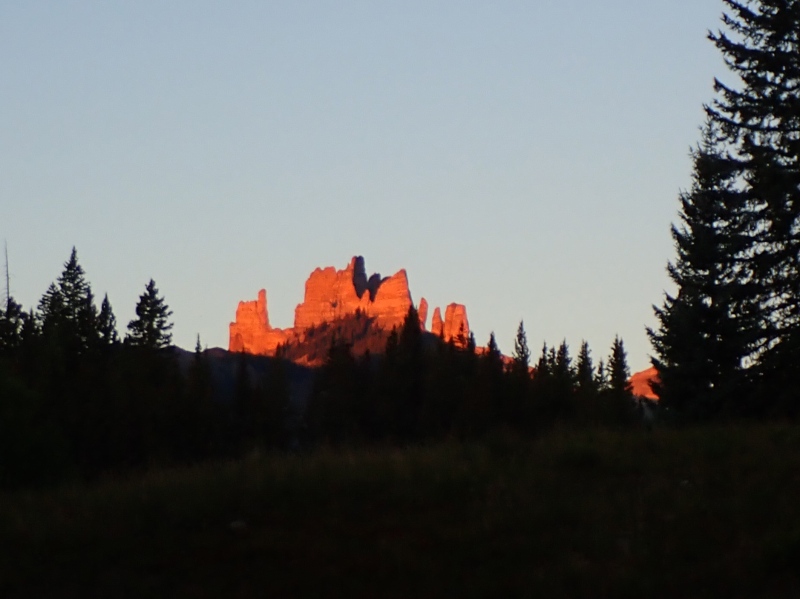
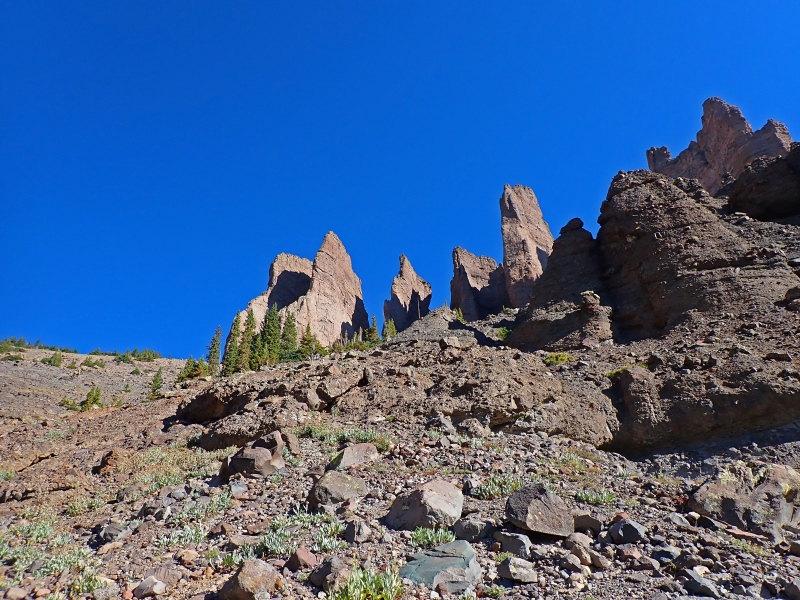
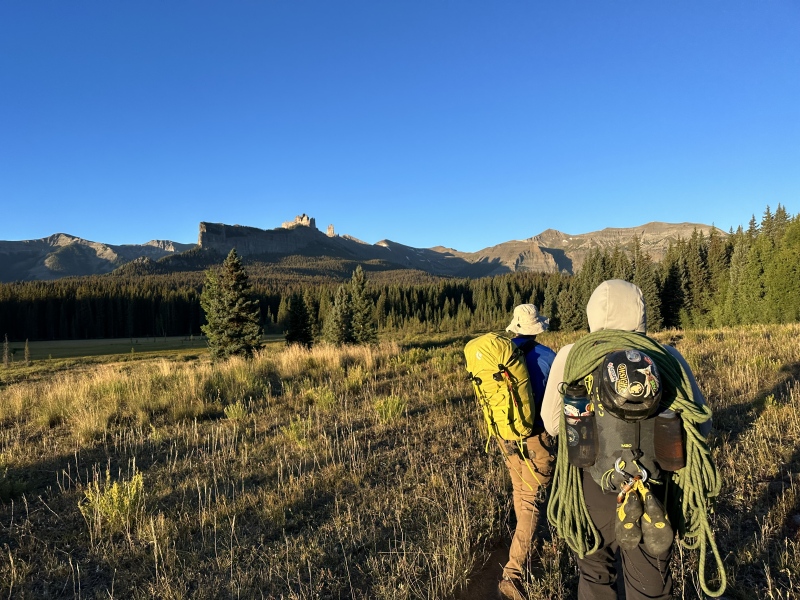
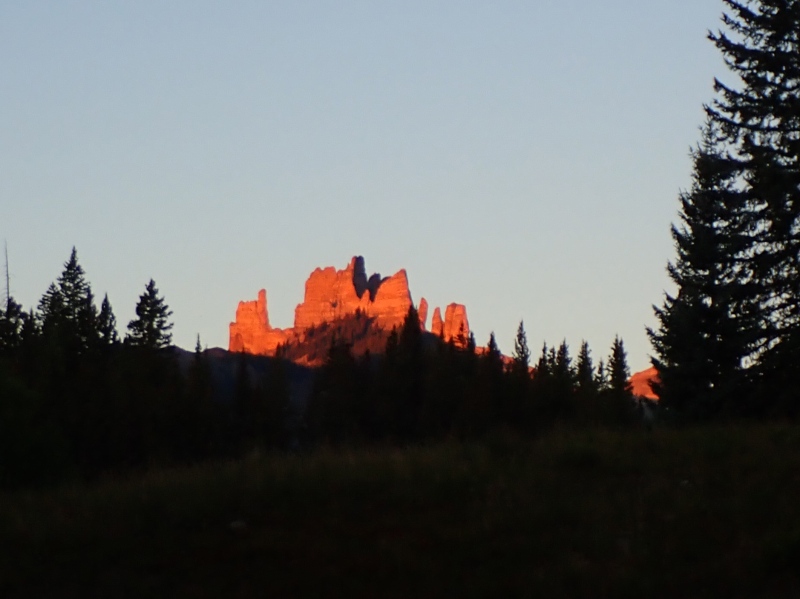
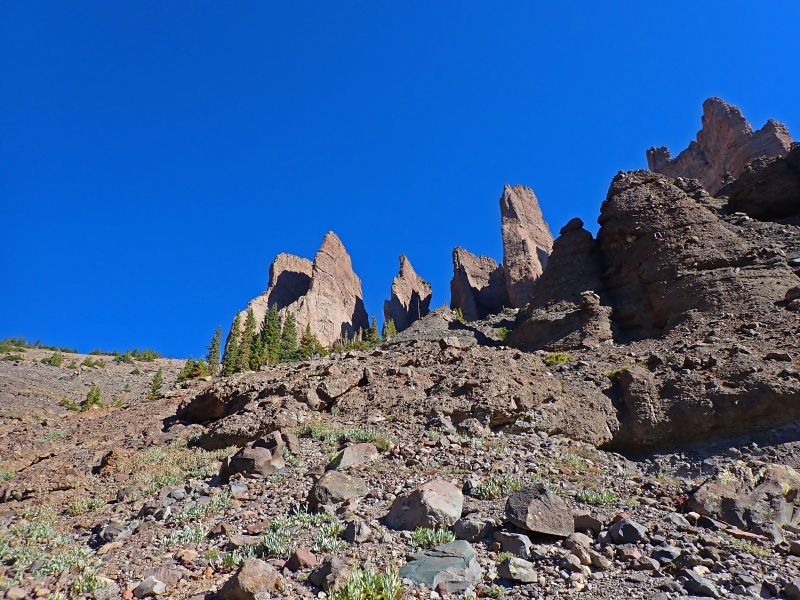
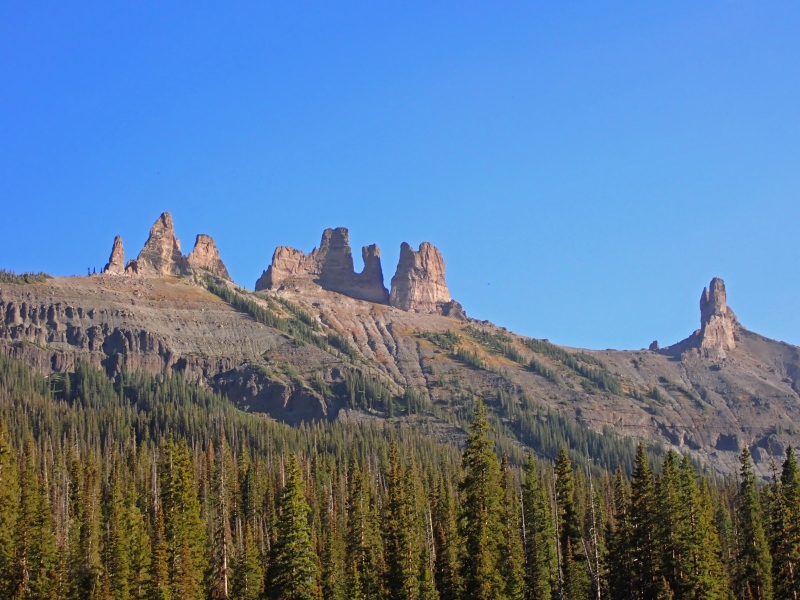
Castles East on the approach. Early morning approach. Photo by Alyson.
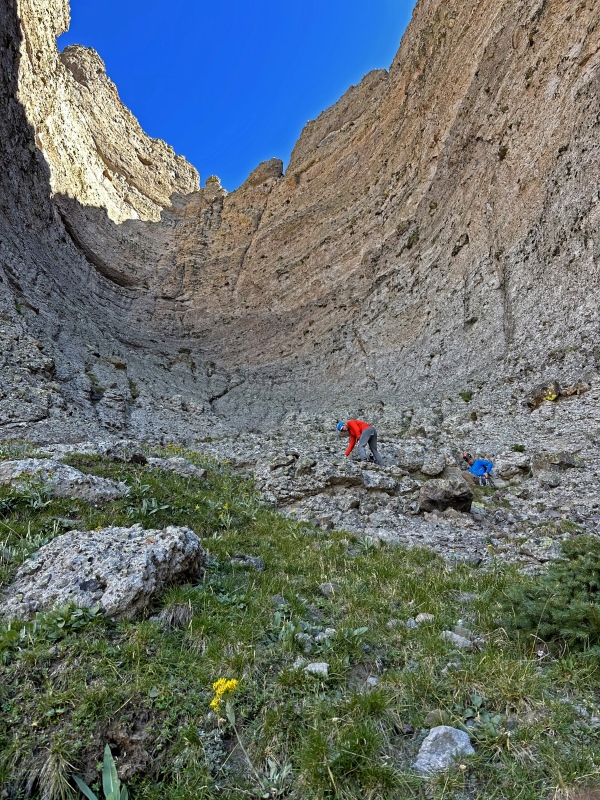
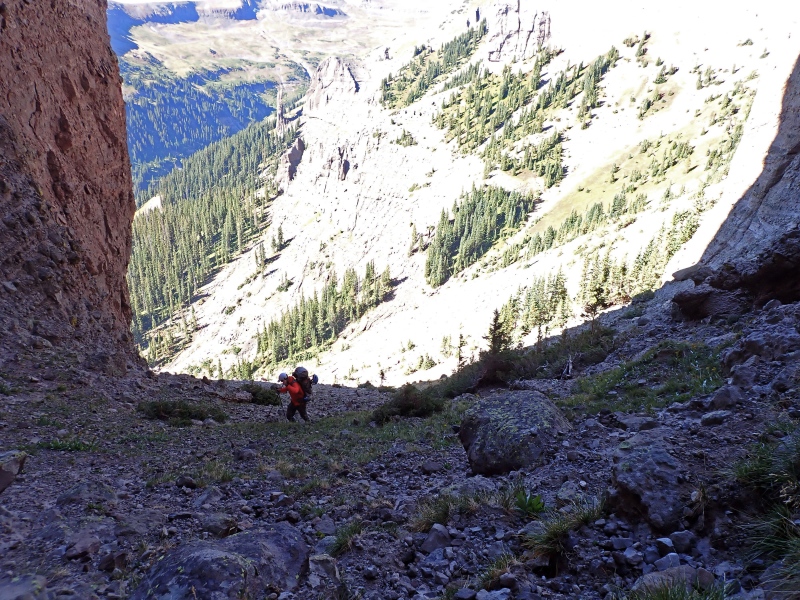
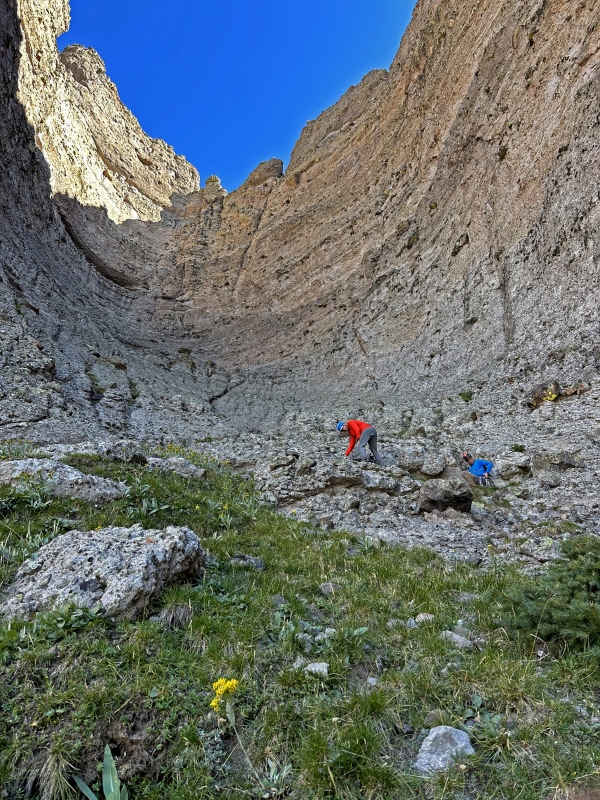
The alarm went off early and we left the Swampy Pass Trailhead at 4:45 AM with day packs. We followed the Swampy Pass trail for 0.8 mile to a junction. In the dark, without coffee, we took the right turn – continuing on Swampy Pass Trail – when we should have taken the left turn for Pass Creek. We were back on track with a fair bit of extra hiking, another trail, and some extra gain.After ~6.1 miles of hiking, we reached another trail junction, went left on the Mill-Castle Trail, crossed Castle Creek, and continued following the trail south and then southwest until we were on the south side of The Castles. We left the Mill-Castle Trail at a broad open gully that separates Castles East and Castles West. A steep grind up the gully's right (east) side led us to the southwestern chimney complex at the base of Castles East where we reached the bottom of the climb at 9:50 AM. Some loose, hardpan side-hilling was required to get there.
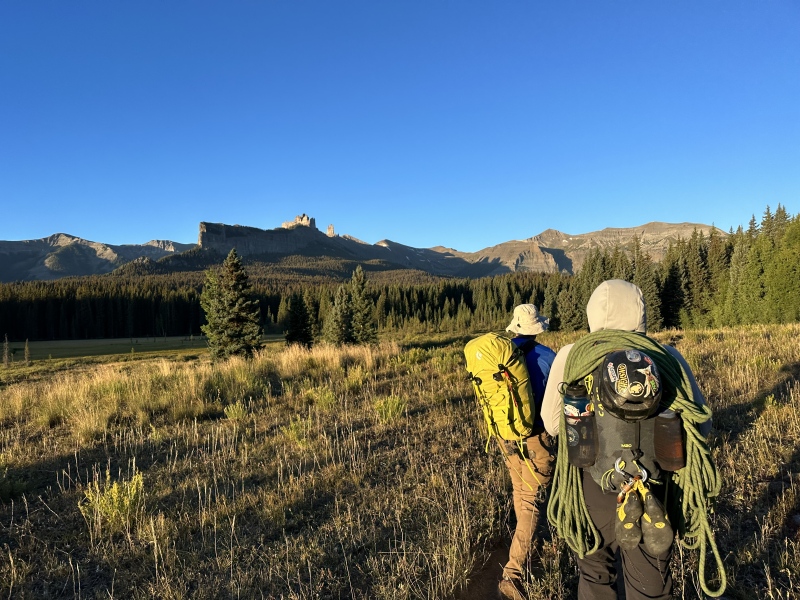
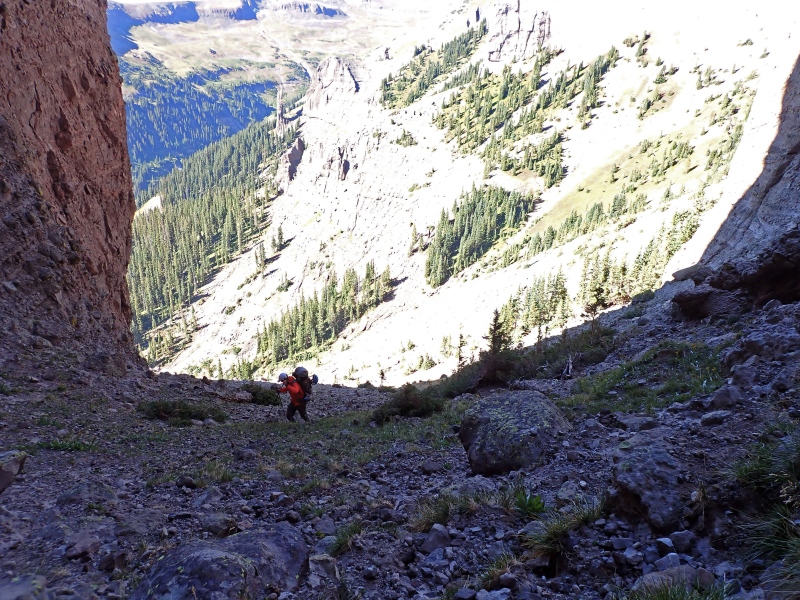
Castles on the approach. The base of the climb. Photo by Alyson.Nearing the top of the approach gully.
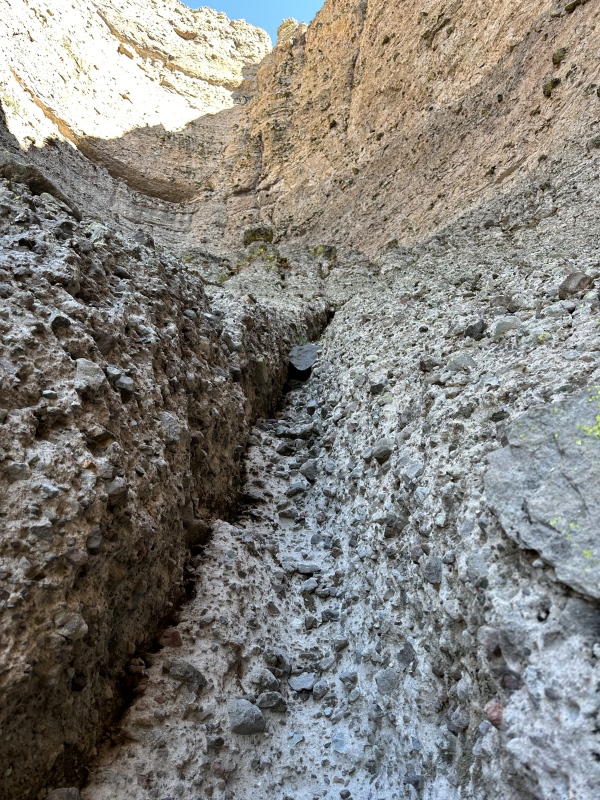
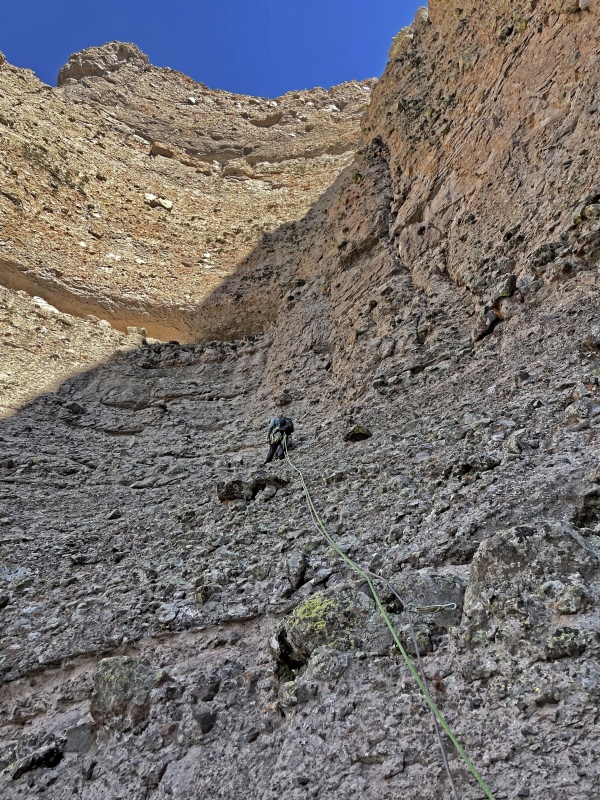
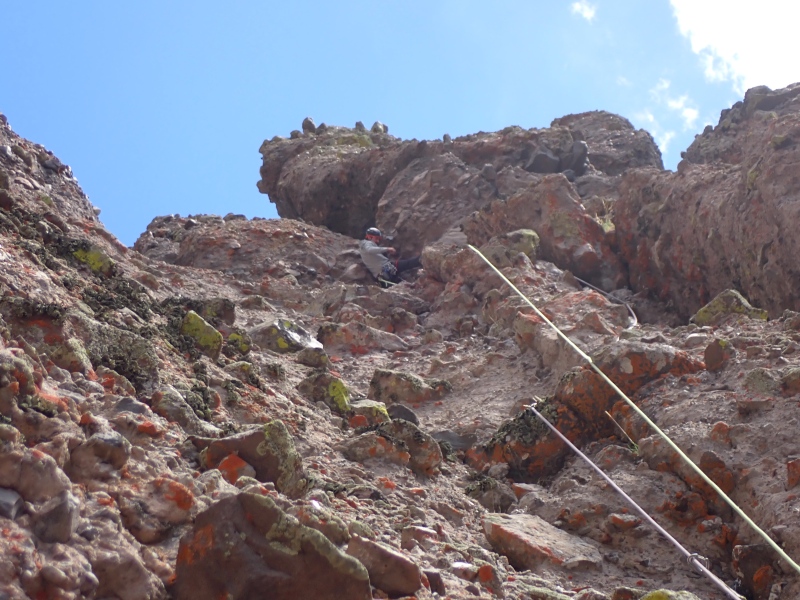
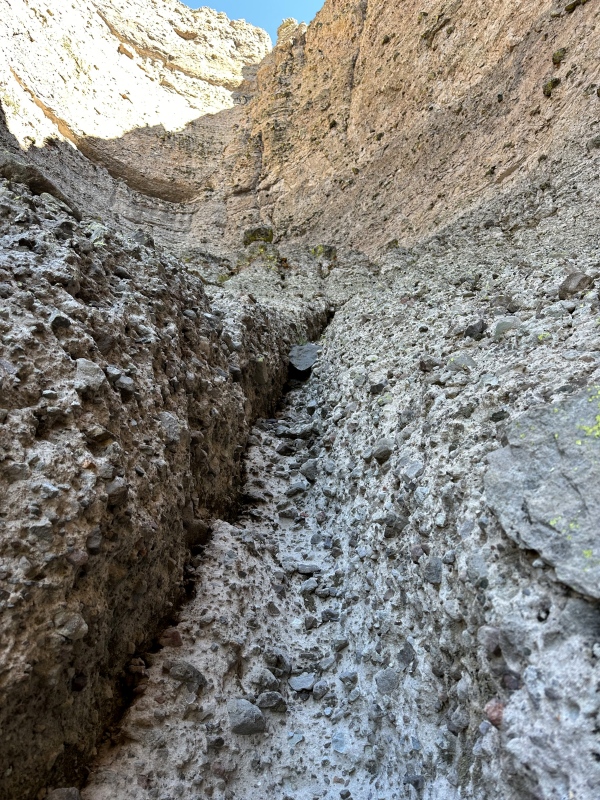
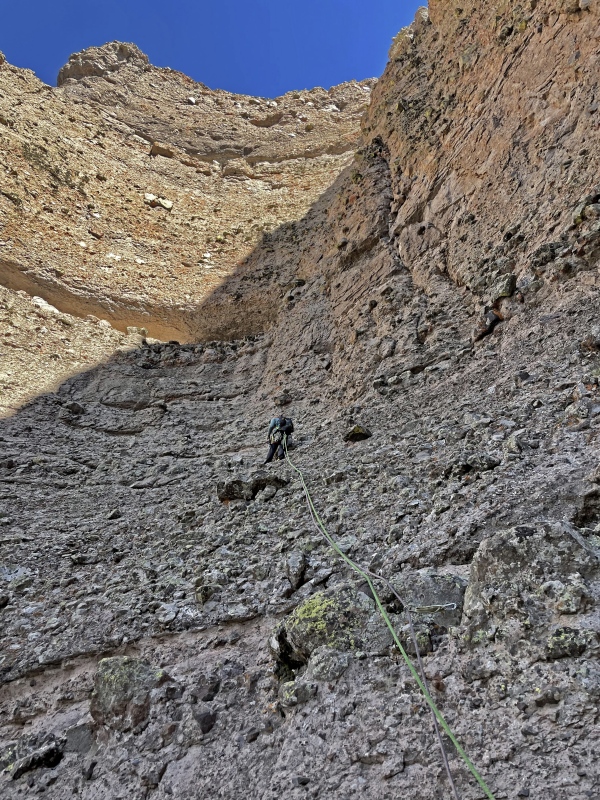
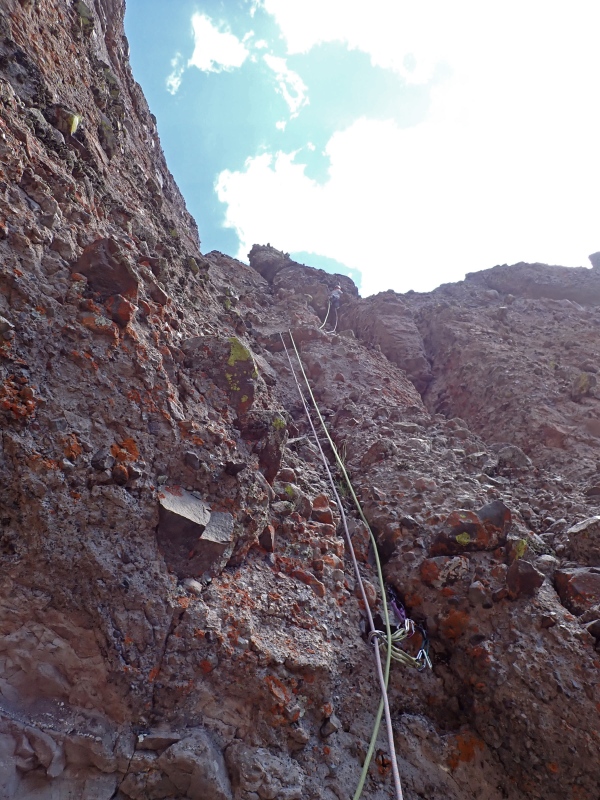
We scrambled up a long section of a class 3-4 gully where I was slated to take the first pitch. I started up the pitch and after 30 feet of climbing, I had gastrointestinal issues. I quickly down-climbed, scampered to the base and took care of business. Not particularly patient, Aiden took the rack and started leading where I left off – I was not complaining, considering the chossy run-out nature of the pitch. The volcanic breccia was less than inspiring.
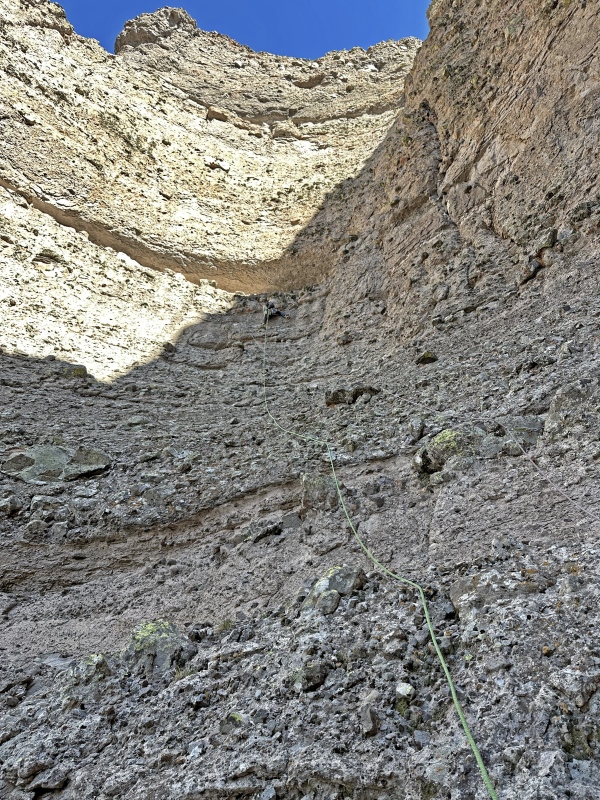
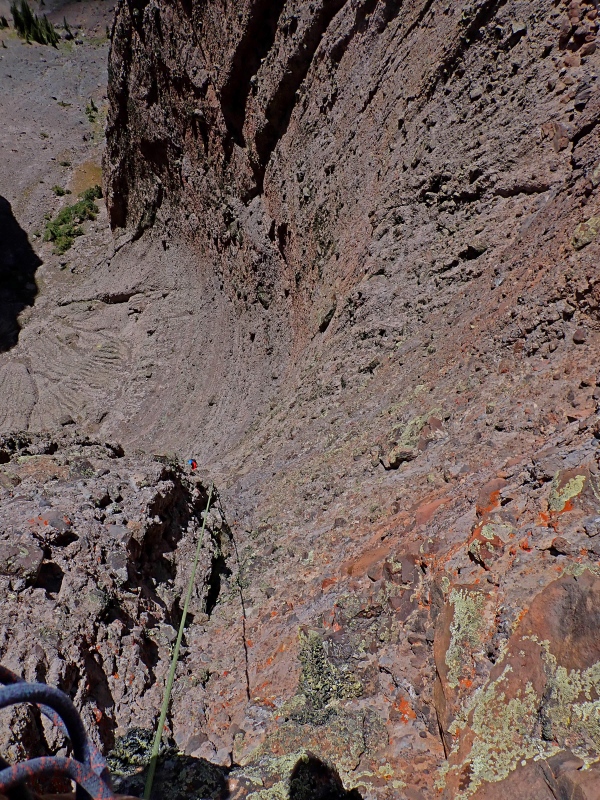
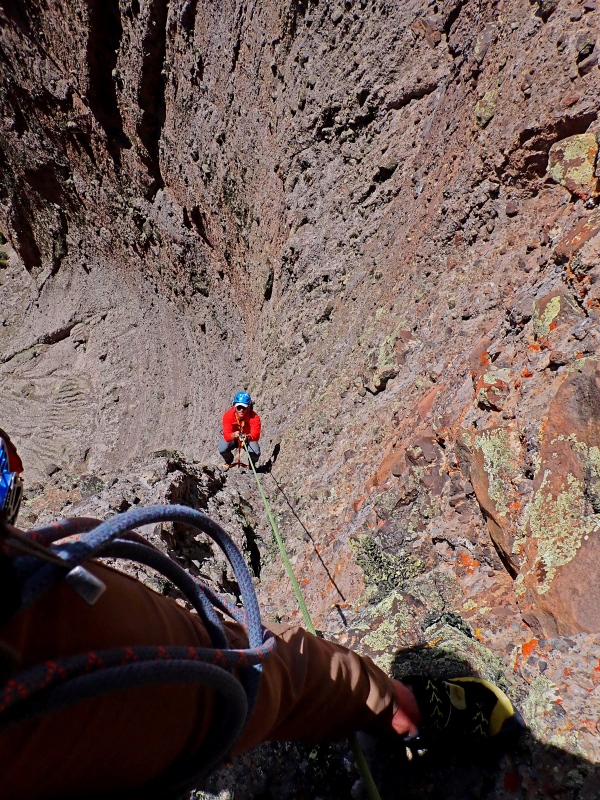
Class 3-4 gully approach. Photo by Alyson.Aiden starting pitch 1. Photo by John.Aiden finishing pitch 1. Photo by Alyson.
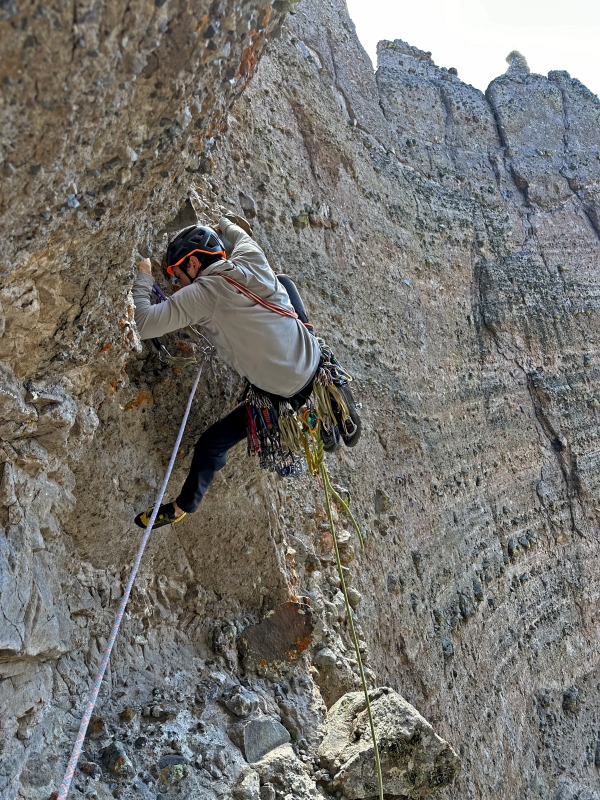
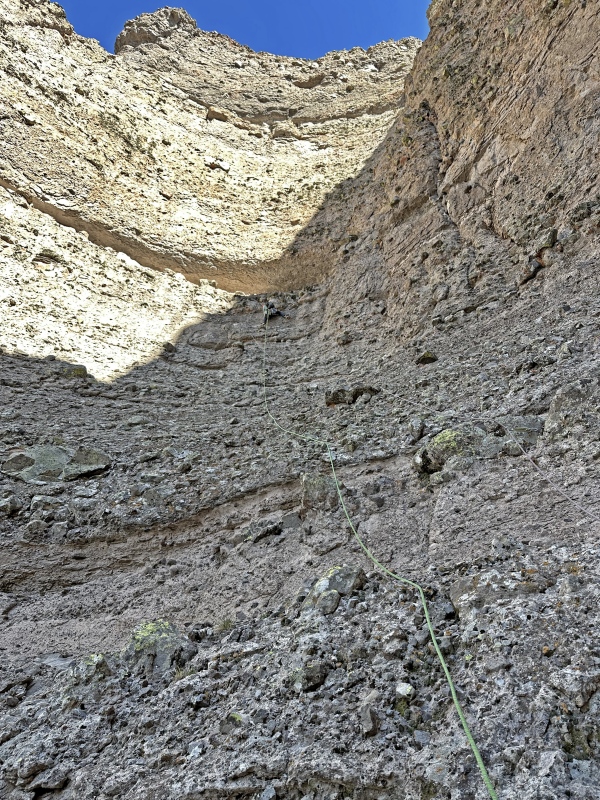
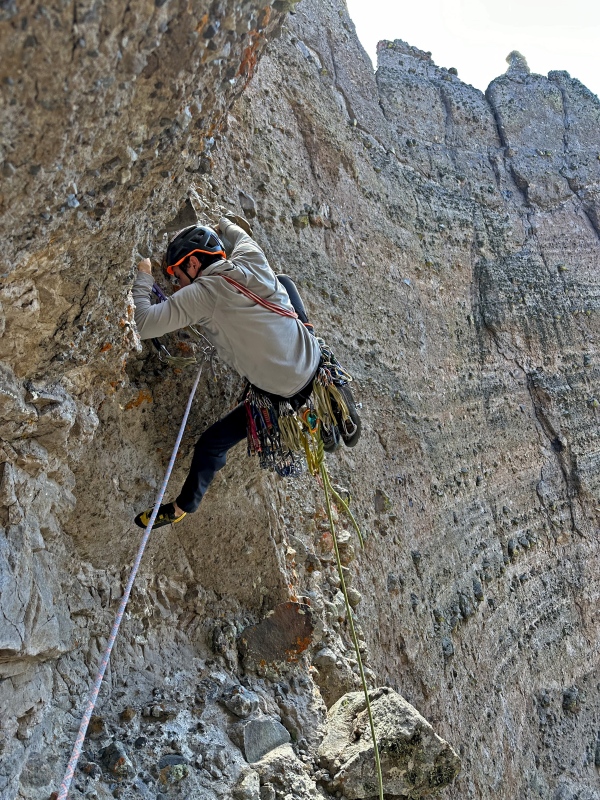
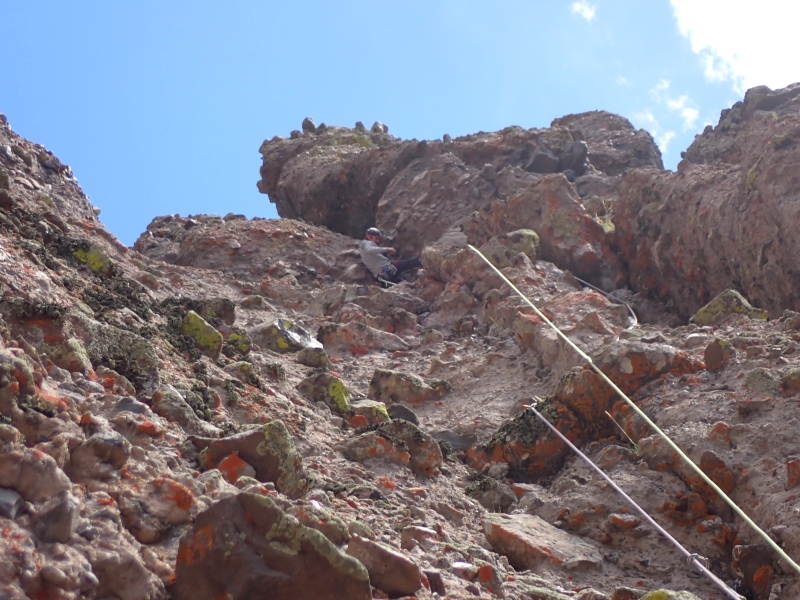
As expected, the first pitch wasn't too challenging but had serious run-out climbing with less than textbook gear. I quickly followed while we set a fixed line for John and Alyson. Aiden led and combined the second and third pitches which topped out at an exposed shoulder belay just before the summit. "Safe" would not be the adjective for these two pitches. Difficult, chossy, not well-protected 5.10 was the name of the game.
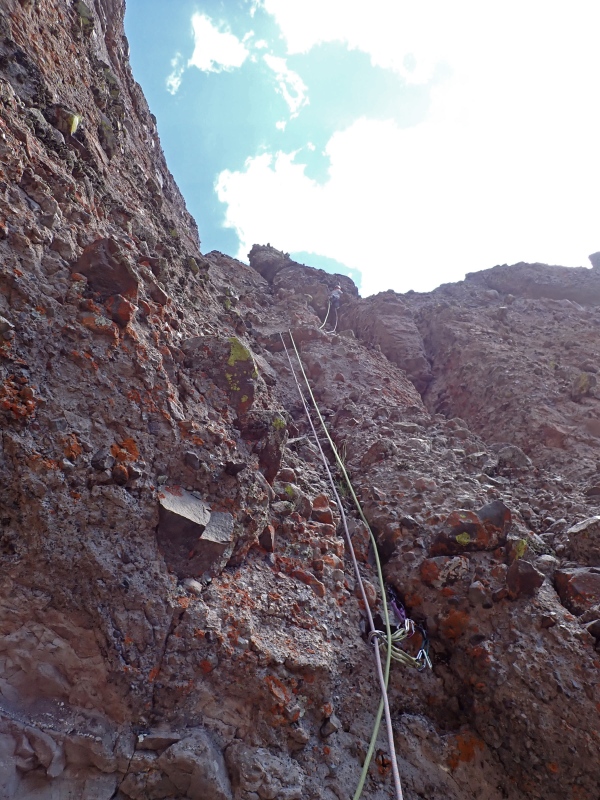
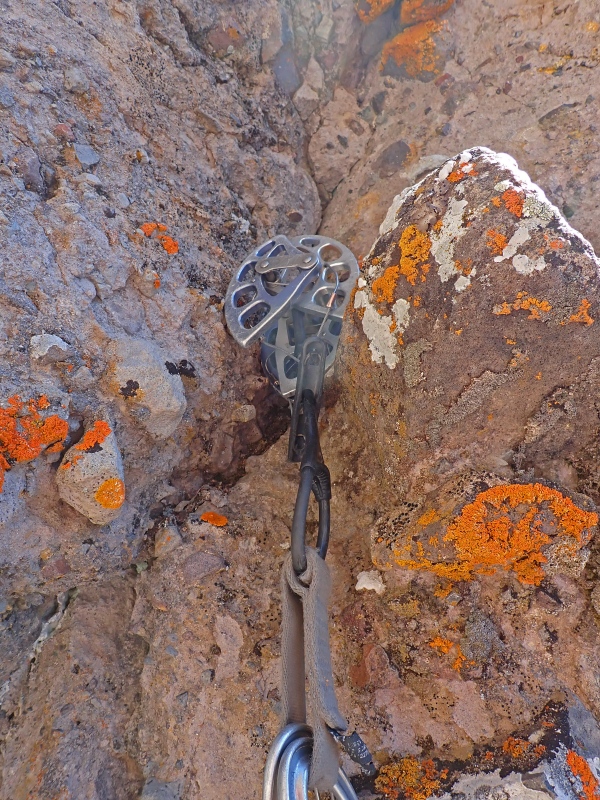
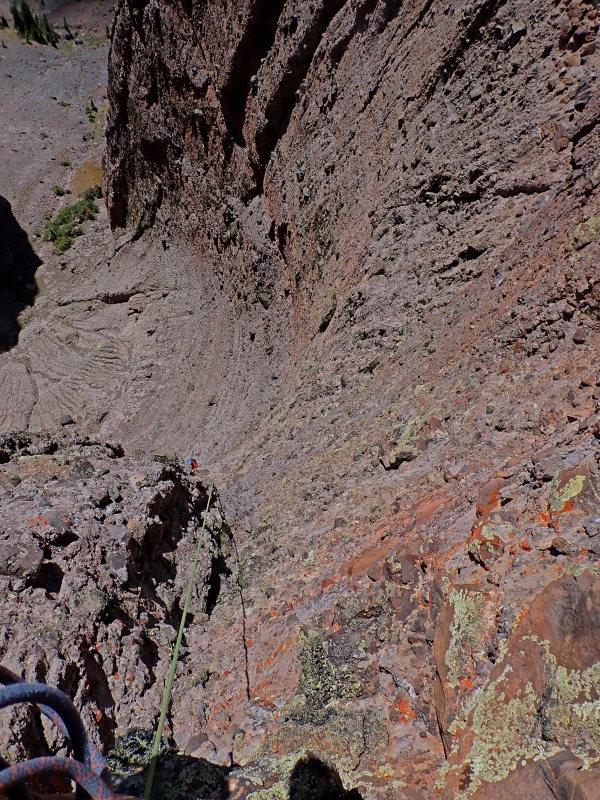
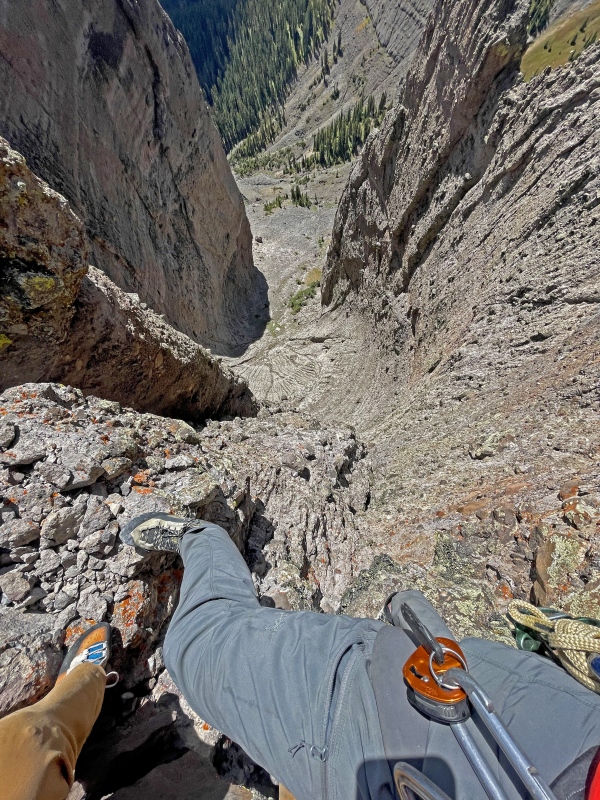
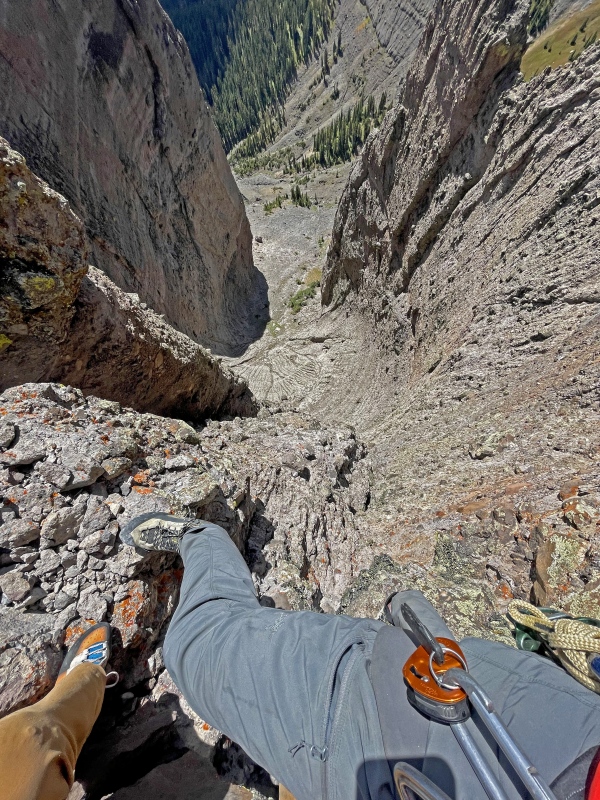
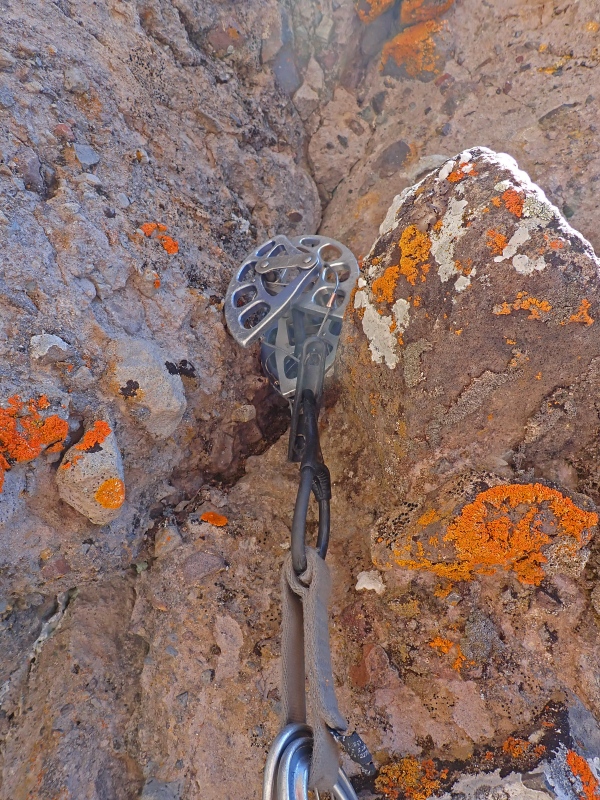
Aiden on the tough start to pitch 2. Photo by Alyson.Aiden working through pitch 3 (combined with pitch 2)Pitch 3 crux.Typical "good" gear. The airy perch at the top of pitch 3. Photo by John.
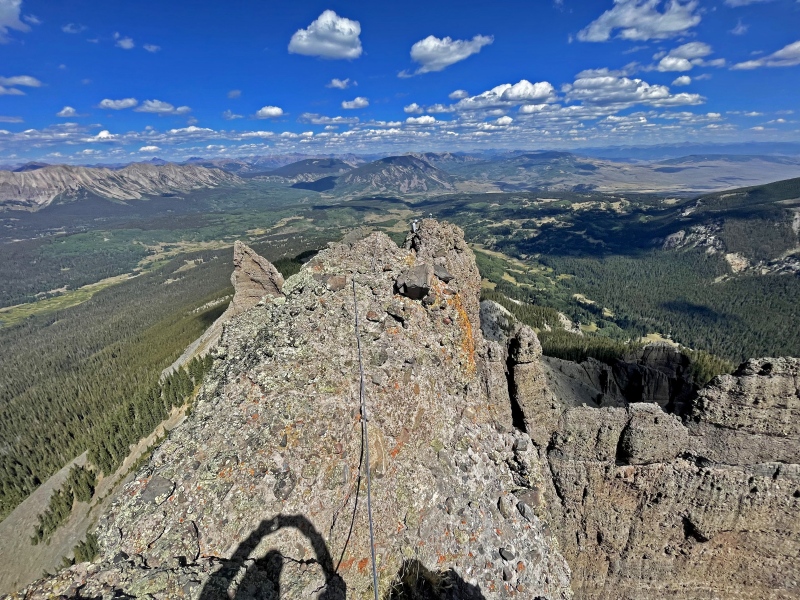
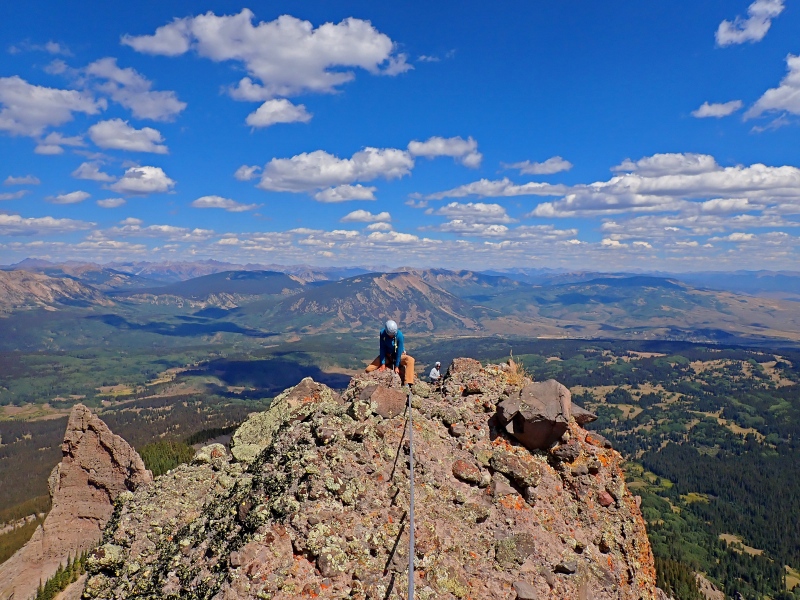
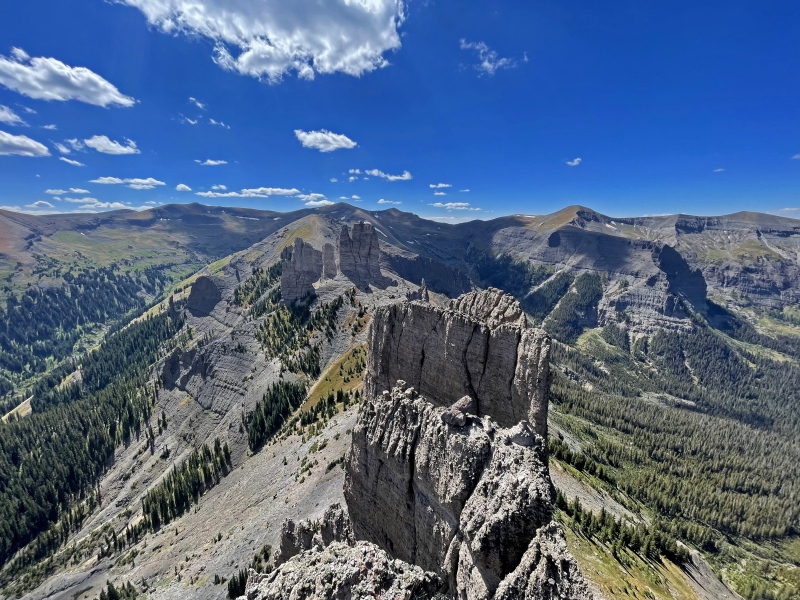
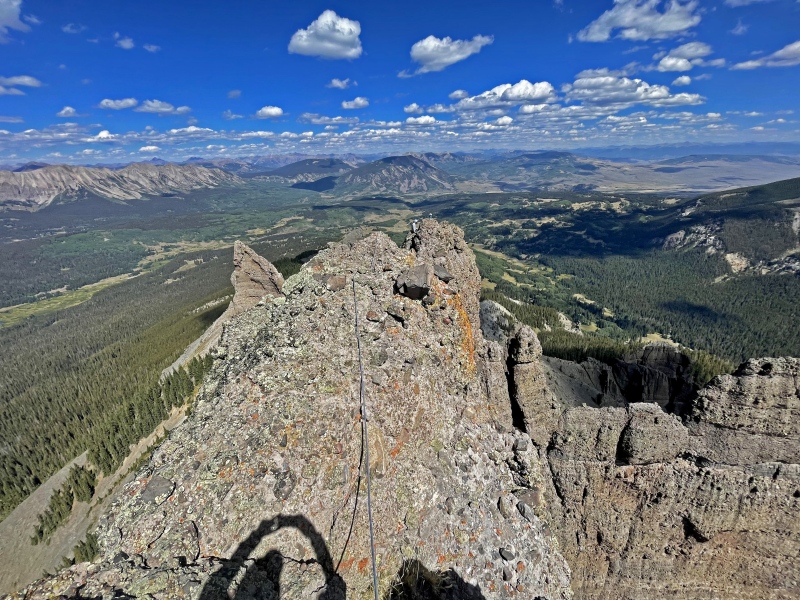
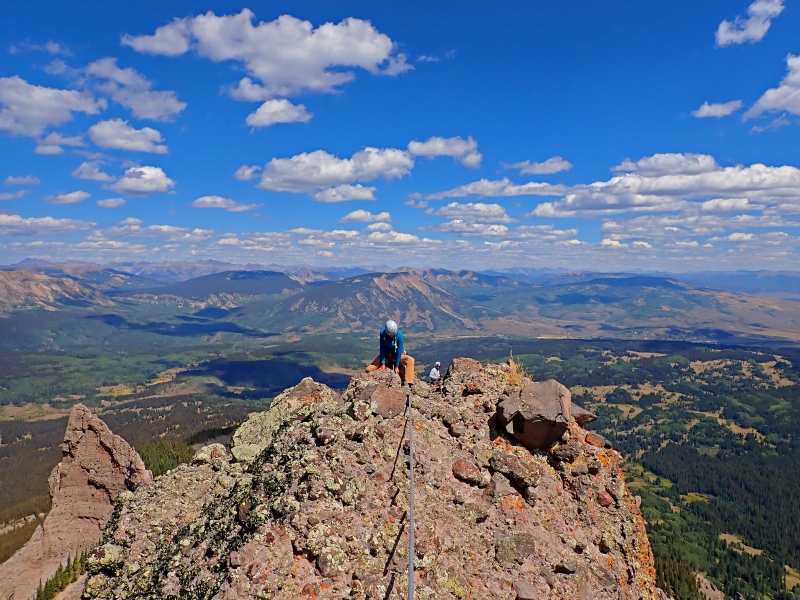
The final pitch to the summit ridge wasn't as exciting and was relatively tame compared to the other pitches. One last final class 4 scramble on the exposed ridge led to the summit. We took turns taking belays to the summit around 1:30 PM. I replaced the fixed tri-cam on the summit and we completed a series of three rappels to return to the bottom. Remaining out of the way of falling chossy rock was challenging – not an easy feat with four people. We had our ropes coiled and were all back at the bottom around 3:40 PM. Instead of heading back to the Mill-Castle Trail via the south slopes, we decided to descend more pedestrian grassy slopes north from the West-East saddle. Although the descent was easier, the bushwhack once in the valley was not. Plenty of downed trees and swampy areas on the north side made travel semi-miserable. It's a coin toss for which way is better—bushwhack and swamp vs. hardpan and loose.
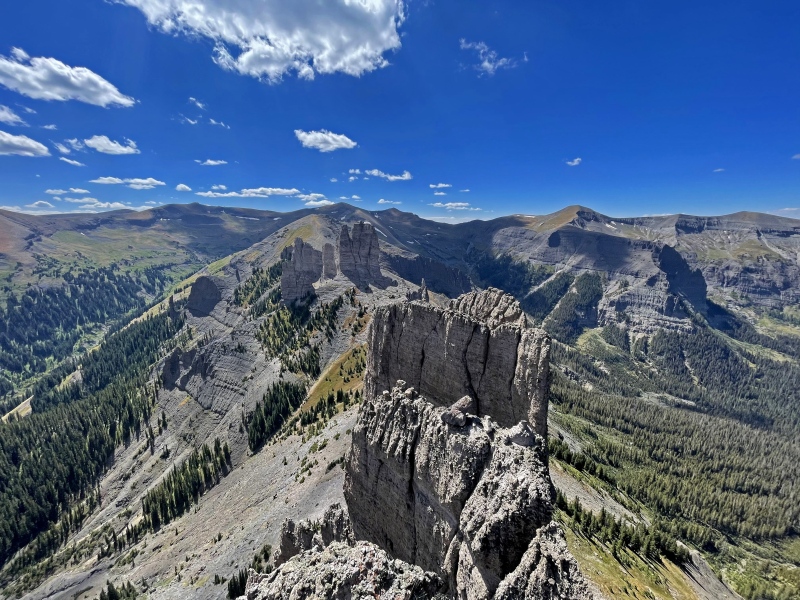
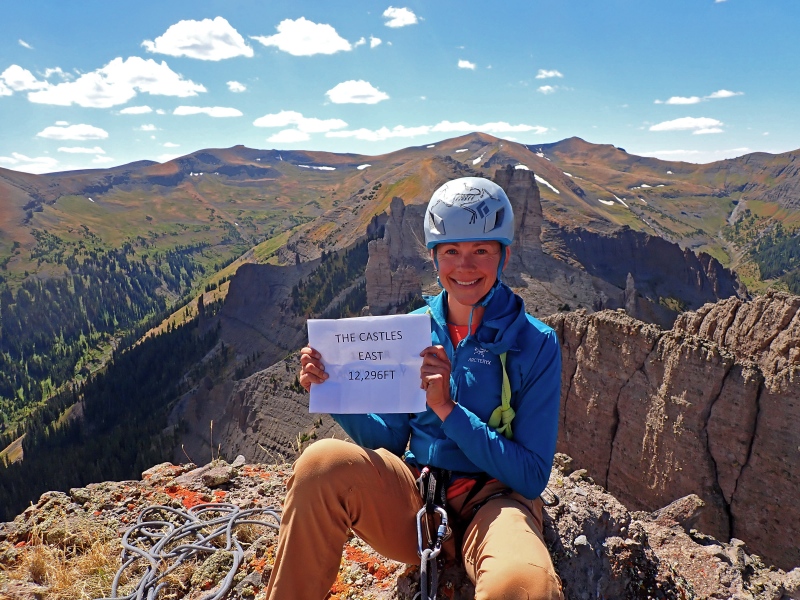
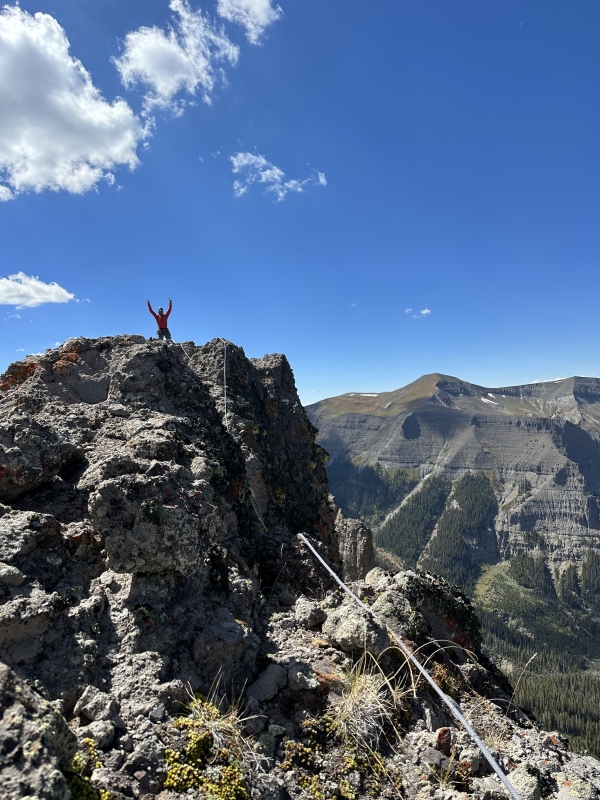
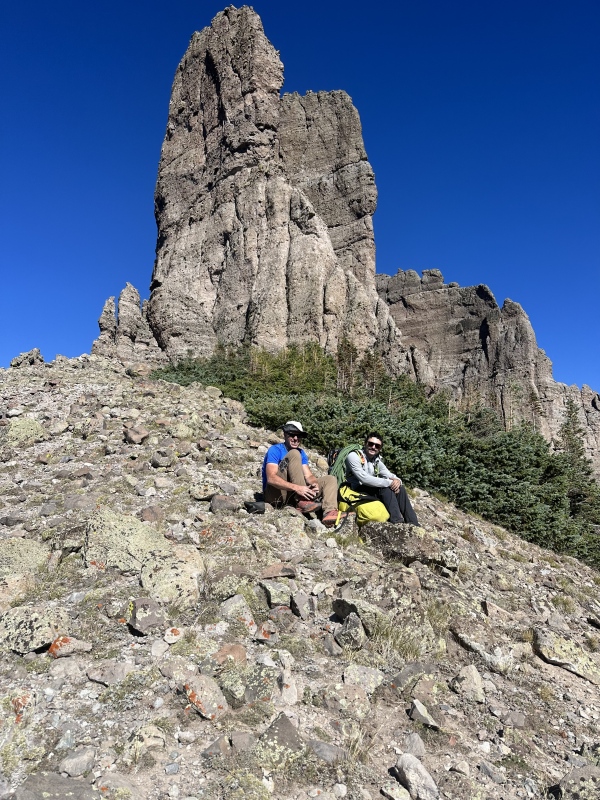
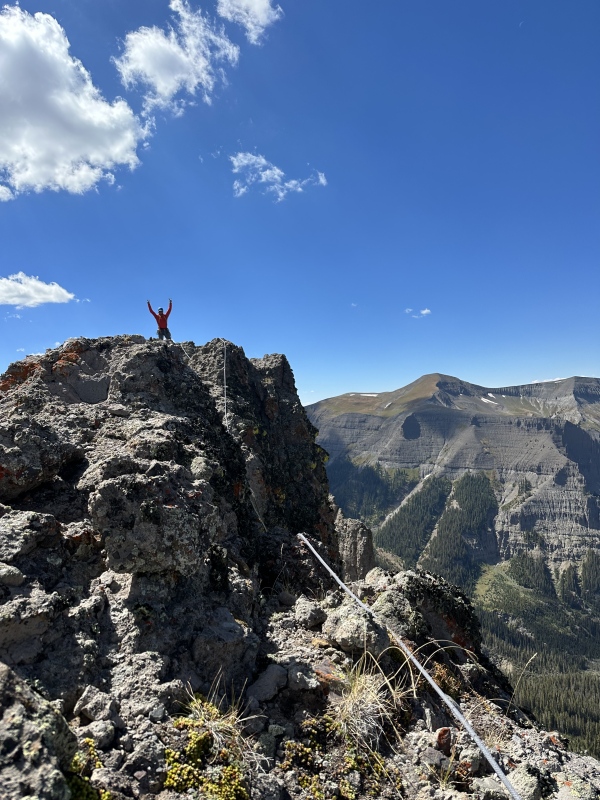
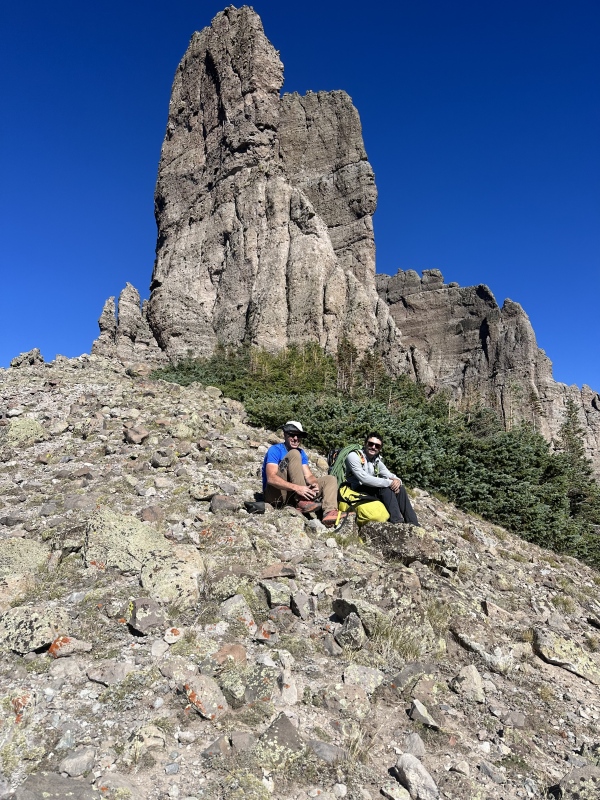
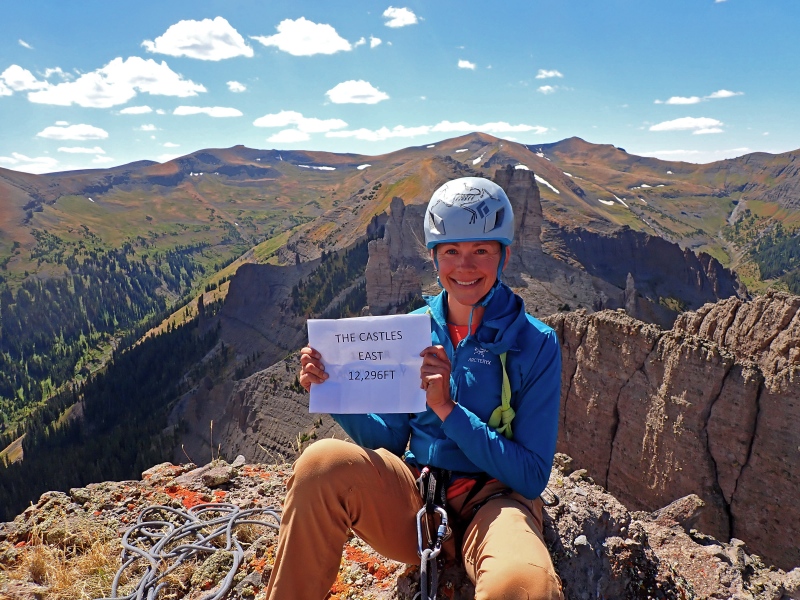
Looking back at the summit ridge. Photo by John.Summit views. Photo by John.Alyson nearing the summit.Alyson on the summit.John on the summit. Photo by Alyson.Myself and Aiden near the Castles West/East saddle. Photo by Alyson.
After intersecting the trail, we thoroughly enjoyed our 7 mile slog back to the trailhead where we arrived just after dark at 8:10 PM—a fantastic long day knocking out the most challenging ranked 12er in Colorado. Congratulations to Alyson for completing the 12ers along with John (I believe at the time of writing, he's only got one class 2 slog left). Also, a shout-out to Aiden for climbing with a solid lead head. I was just tagging along to carry the rack and say farewell to my pink tri-cam that we left on the summit.
Route Info:
The original topo of “5.10 WTF” is valid. It's precisely that, “5.10 WTF.”
Scramble 100 feet up a fluted gully (class 4 near the top) to a stance at the start of pitch one.
Pitch 1: Aim for a wide overhanging cave. Begin up low-angled terrain (low 5th) to a steepening headwall. Get bad gear before the headwall and climb the headwall (5.8 R) to the overhanging cave with a two-bolt anchor. It might be possible to “sling” large cobbles for protection. 5.8 R, ~90 feet
Pitch 2: Step right and climb an overhanging bulge with an incipient crack (5.10a PG-13). Probably don't want to blow the moves – likely a factor 2 fall. Once through the bulge, follow the crack as it disappears (5.7). Carefully step right–exposed–into a chimney (5.7-8 R) and climb the chimney with some gear to a ledge with a 2-bolt anchor backed up by a good hand crack. 5.10a R, ~75 feet
Pitch 3: Climb the overhanging hand crack above the bolted anchor. The climbing is harder and the rock is chossier but better protected (5.10b PG). Once through the overhang, continue up the chimney (5.6). As the chimney peters out, veer left (5.8 R) and climb to an airy perch and bolted belay. It's easy to combine pitch 2 and 3 into one scary pitch. 5.10b R, ~65 feet
Pitch 4: From the airy perch, step right and traverse 15 feet right on a very exposed ledge to a crack system. Follow the crack to the top. A single bolt anchor backed up with gear. 5.7 PG-13, ~50 feet
Pitch 5: Scramble along the summit ridge to the summit. Class 4, ~60 feet
Rack: Single BD #0.3-4, doubles #1-4, optional #5-6. Lots of long runners. Double 70M helps with the descent but is not required.
Rappel Beta
Rappel 1: From the summit, rappel 60 feet from the single bolt and fixed piece of gear (as of 2023 with a new pink tri-cam). The original tri-cam was very sun-rotted so expect to leave a pink tri-cam or BD #0.5. Rope pull is problematic due to drag over the summit cobbles.
Rappel 2: With TWO 70M ropes, rappel 220 feet to the bottom of pitch 1. This provides clean rope pull so the rope doesn't get stuck on cobbles.
Optional Rappel 3: If you're not bringing double 70s, this is your option, I think. It might be possible to rappel with a single 70M from the top of pitch 3 to the top of pitch 1. Rope pull could be problematic due to the angle under the roof and cobbles. From there, a single rope rappel goes to the bottom of pitch 1. Or rappel every pitch. Bring lots of webbing to replace tat.
It's disappointing that the 2017 FA used Rawl Buttonhead bolts; that was maybe acceptable in the 70s. At least the second bolt is a 5-piece sleeve bolt (2” so still not awesome – indicated by the B stamp). Each bolted belay has a single button head and a single 5-piece sleeve.
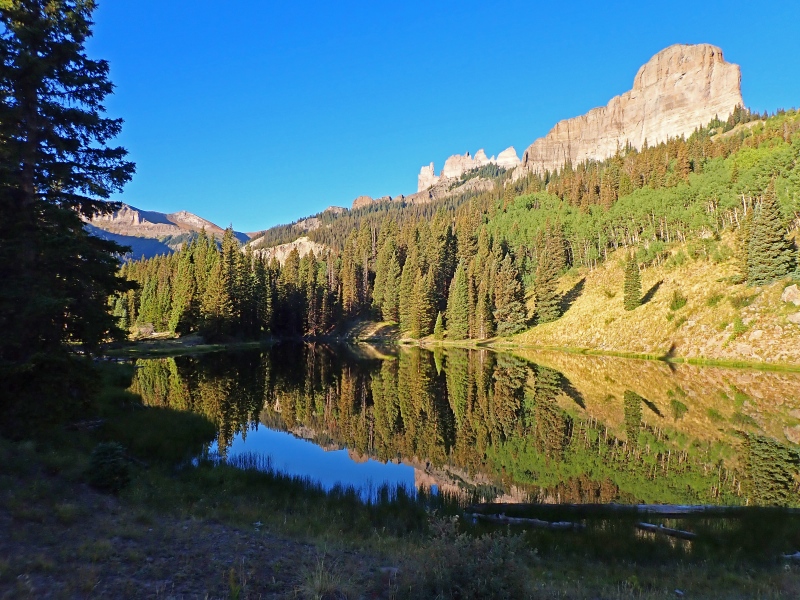
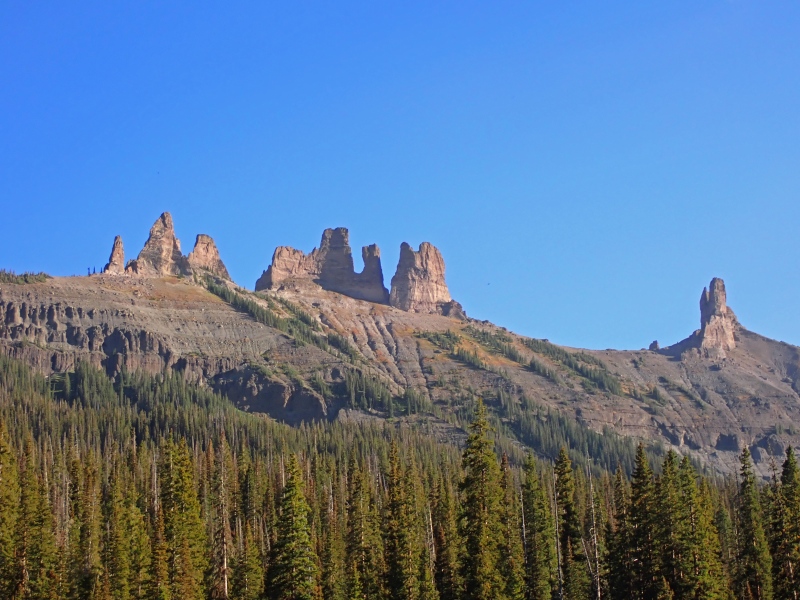
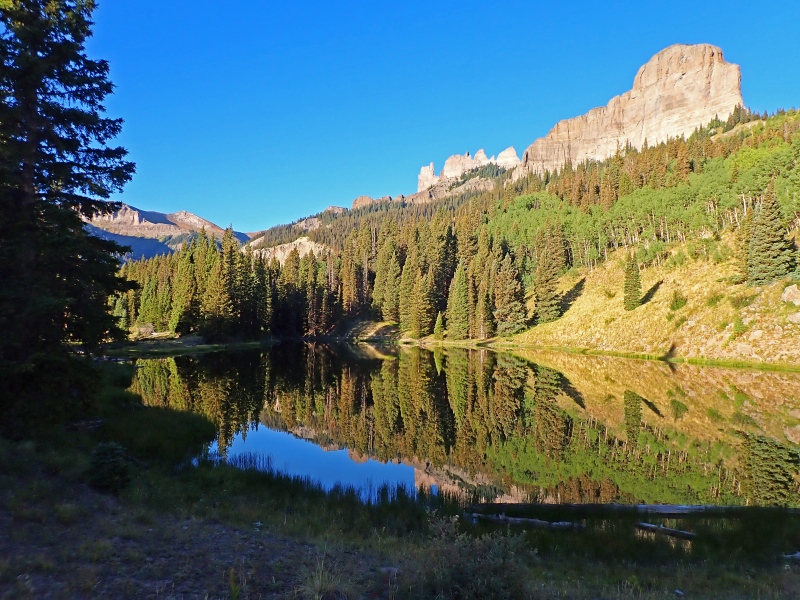
Castles East on the exit hike.
Thumbnails for uploaded photos (click to open slideshow):
What a stunning, terrifying formation. I thought Turret Ridge was amazing--this looks to up the difficulty, danger, and wildly exposed cobblestone catwalk summit qualities significantly. Congrats on an adventurous climb!
That all four of you made it safely up and down. Even if my climbing ability was up to the challenge, I dont think my risk tolerance is. Excellent info!
... during the reading of this TR, because this is pucker factor 10. Super cool formations but man that rock looks manky. Awesome climb Derek, Kirks, and Aiden!
Great TR as always, Derek! Good to know not all of it is 5.10, but I will probably end up in the "all but scary" club. I doubt there's many who would be game to lead this!
Awesome work to you all, and congrats again to Aly on her finisher! Invaluable beta for this peak, though sadly I won't ever use it. Above my pay grade, lol. Those are some amazing looking formations though, I remember admiring them from West Elk years ago.
boooyy!!!!! I'll echo what others have said. Some balls and prolonged pucker on this. And it's great to see a report from you.
The pics are stellar. Loved the close up shots. PROPS!!
So 5.10WTF after all? I admit I wondered about that rating, great job knocking this one out. Rock looks a lot like Turret Ridge, which I perversely sort of enjoyed. But geez...buttonheads?!? I thought those died in the Platte in the 80's. Congrats again!
Appreciate the honesty with the GI issues, tying in for the first pitch of the day is more effective than any cup of coffee.
Sick climb, thanks for the great TR.
This trip report and Furthermore's comanion route comment on mountainproject) contain lots of extremely helpful to essential beta which greatly facilitated my ascent of this route. However, I feel this both sources considerably overstate both the difficulty and seriousness of this climb (as, to the best of my knowledge, do all other published sources on this peak and route).
I did this in a party of three and we all agreed that pitch 1 was easier than the rating in this TR; two of us felt that rest of the ratings were also soft but one felt they were accurate. I lead all the pitches and felt that while this climb is quite a serious undertaking, no pitches deserved an R rating. (My two companions felt pitch one deserved an R rating). I was able to place far more (and better) protection than the photos indicate Aiden did. For example, in the photo of "Aiden working through pitches 2 and 3", he appears to have no pro between him and the P2 crux; I had about eight decent placements in that stretch of climbing.
Ignoring the choss factor, the climbing on this route is easier than, for example, Yellow Spur. Someone who would be comfortable leading any of the pitches on Turret Ridge should be able to safely lead this route. While this route has a much more demanding approach and more and harder climbing than Turret, I felt that Turret has two sections that are sketchier than anything on this route.
For my money, Castles East is a top ten Colorado peak and this is the best of the only-way-to-the-summit-of-a-ranked-Colorado-12er-13er-or-14er-routes. Much thanks to Furthermore for providing the beta that enabled our group's ascent.
Caution: The information contained in this report may not be accurate and should not be the only resource used in preparation for your climb. Failure to have the necessary experience, physical conditioning, supplies or equipment can result in injury or death. 14ers.com and the author(s) of this report provide no warranties, either express or implied, that the information provided is accurate or reliable. By using the information provided, you agree to indemnify and hold harmless 14ers.com and the report author(s) with respect to any claims and demands against them, including any attorney fees and expenses. Please read the 14ers.com Safety and Disclaimer pages for more information.
Please respect private property: 14ers.com supports the rights of private landowners to determine how and by whom their land will be used. In Colorado, it is your responsibility to determine if land is private and to obtain the appropriate permission before entering the property.